
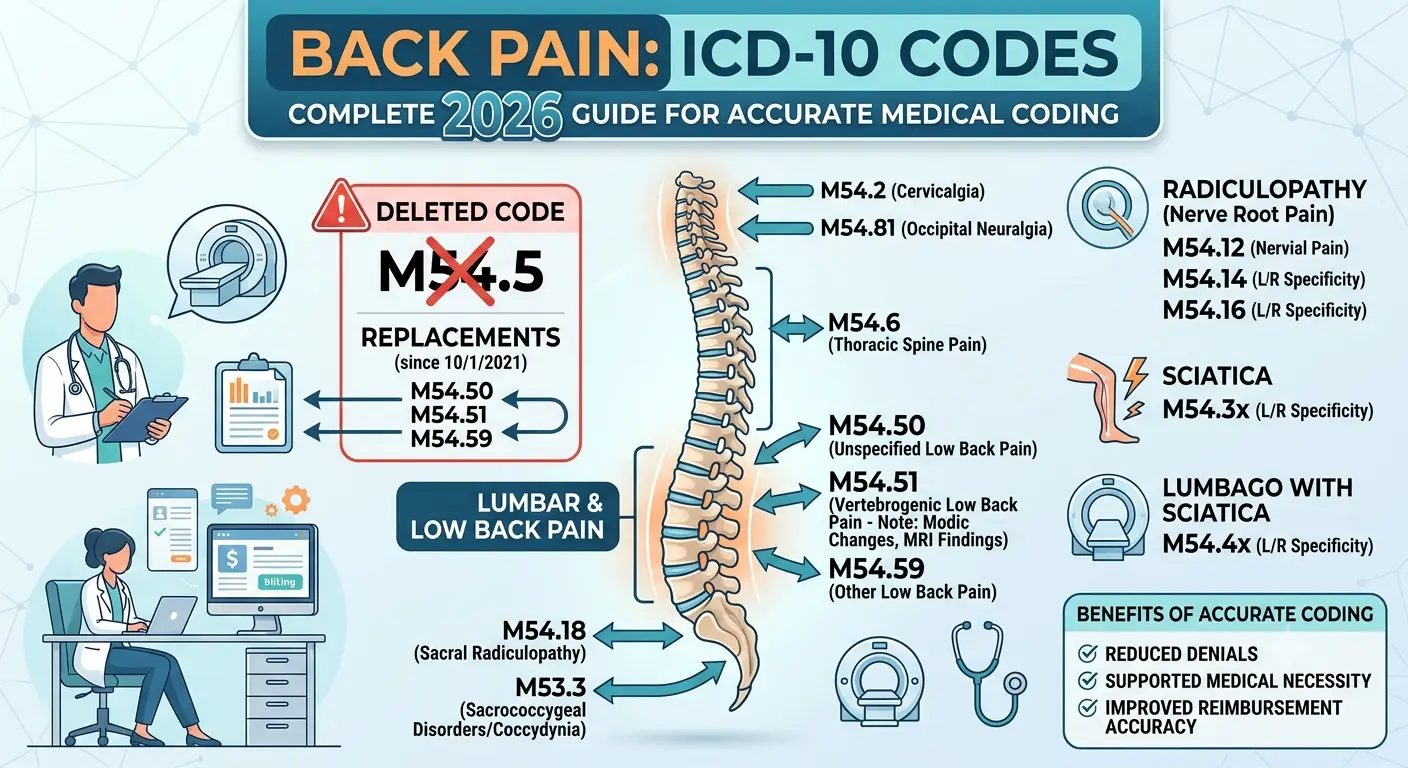
Back pain remains one of the leading causes of doctor visits across the United States. Millions of people experience spinal pain every year, making accurate ICD-10 coding essential for healthcare providers, coders, and billing specialists. Proper code selection helps reduce denials, supports medical necessity, and improves reimbursement accuracy.
The ICD-10 code family for back pain falls under the M54 category, also known as dorsalgia. These codes classify pain according to the affected spinal region, including the cervical, thoracic, lumbar, and sacral areas.
One of the most important updates in recent years involved the deletion of ICD-10 code M54.5. Since October 1, 2021, this code has no longer been billable. Healthcare providers must now use one of the replacement codes: M54.50, M54.51, or M54.59 depending on the documentation.
Understanding the M54 ICD-10 Code Family
The M54 category includes several types of spinal pain conditions such as:
- Neck pain
- Thoracic spine pain
- Low back pain
- Sciatica
- Radiculopathy
- Lumbago with sciatica
Each code is assigned based on the location and nature of the pain rather than body side, except in conditions like sciatica where laterality matters.
Cervical Spine Pain ICD-10 Codes
Neck pain is commonly coded using M54.2.
| ICD-10 Code | Description |
|---|---|
| M54.2 | Cervicalgia |
| M54.81 | Occipital neuralgia |
M54.2 – Cervicalgia
This code is used when documentation states neck pain without confirming a more specific spinal disorder such as cervical disc disease or cervical spondylosis.
M54.81 – Occipital Neuralgia
M54.81 applies to nerve-related pain affecting the occipital nerves located near the base of the skull.
Thoracic Back Pain ICD-10 Codes
Pain located in the middle or upper back typically falls under thoracic spine pain coding.
| ICD-10 Code | Description |
|---|---|
| M54.6 | Pain in thoracic spine |
The same code is used for:
- Mid back pain
- Upper back pain
- Middle back pain
Lumbar and Low Back Pain ICD-10 Codes
Low back pain coding changed significantly after the removal of M54.5.
| ICD-10 Code | Description |
|---|---|
| M54.50 | Low back pain, unspecified |
| M54.51 | Vertebrogenic low back pain |
| M54.59 | Other low back pain |
M54.50 – Low Back Pain, Unspecified
Used when the provider documents general low back pain without identifying a specific cause.
M54.51 – Vertebrogenic Low Back Pain
This code describes pain originating from vertebral endplates and usually supported by MRI findings showing Modic type 1 or type 2 changes.
It is commonly linked to basivertebral nerve ablation procedures.
M54.59 – Other Low Back Pain
Applied when the pain presentation is more specific but does not meet criteria for M54.50 or M54.51.
Why M54.5 Cannot Be Used Anymore
The former low back pain code M54.5 became invalid on October 1, 2021. Claims submitted with this deleted code are typically denied automatically.
Healthcare organizations should update all templates and billing systems to prevent outdated code use.
Sacral and Coccygeal Pain Codes
Certain pain conditions affect the lower spine and tailbone area.
| ICD-10 Code | Description |
|---|---|
| M54.18 | Sacral and sacrococcygeal radiculopathy |
| M53.3 | Sacrococcygeal disorders |
M53.3 is often used for tailbone pain, also called coccydynia.
Unspecified Back Pain Code
| ICD-10 Code | Description |
|---|---|
| M54.9 | Dorsalgia, unspecified |
This code should only be used when documentation lacks enough detail to identify the spinal region.
Using M54.9 with spinal procedures often results in claim denials because procedures must match a clearly documented anatomical region.
Radiculopathy ICD-10 Codes
Radiculopathy refers to nerve root irritation that causes pain radiating from the spine into the arms or legs.
| ICD-10 Code | Description |
|---|---|
| M54.12 | Cervical radiculopathy |
| M54.14 | Thoracic radiculopathy |
| M54.16 | Lumbar radiculopathy |
| M54.17 | Lumbosacral radiculopathy |
M54.16 – Lumbar Radiculopathy
One of the most frequently used codes in orthopedic and pain management billing. It applies when lumbar nerve irritation causes symptoms into the lower extremities.
Sciatica ICD-10 Codes
Sciatica coding includes laterality.
| ICD-10 Code | Description |
|---|---|
| M54.30 | Sciatica, unspecified side |
| M54.31 | Sciatica, right side |
| M54.32 | Sciatica, left side |
Lumbago With Sciatica Codes
When low back pain and sciatica are both documented together, use the M54.4 category.
| ICD-10 Code | Description |
|---|---|
| M54.40 | Lumbago with sciatica, unspecified side |
| M54.41 | Lumbago with sciatica, right side |
| M54.42 | Lumbago with sciatica, left side |
Avoid billing separate low back pain and sciatica codes together when M54.4x fully describes the condition.
When to Use M54 Codes vs. Specific Spinal Diagnoses
M54 codes are symptom-based codes. If the provider confirms an underlying spinal disorder, the confirmed diagnosis should usually be coded first.
Examples include:
- Disc disorders (M50–M51)
- Spondylosis (M47)
- Spondylolisthesis (M43.1)
- Kyphosis or lordosis (M40)
- Acute spinal injuries (S13, S23, S33)
Documentation Requirements for Back Pain Coding
Accurate coding depends heavily on detailed provider documentation.
Essential elements include:
- Exact spinal region
- Pain duration
- Radiation pattern
- Neurological symptoms
- MRI or imaging findings
- Conservative treatment history
Incomplete documentation often leads to coding errors and insurance denials.
CPT Codes Commonly Used With Back Pain Diagnoses
Imaging Procedures
| CPT Code | Procedure |
|---|---|
| 72100 | Lumbar spine X-ray |
| 72110 | Lumbar spine X-ray with multiple views |
| 72148 | Lumbar MRI without contrast |
| 72141 | Cervical MRI without contrast |
Spinal Procedures
| CPT Code | Procedure |
|---|---|
| 62323 | Lumbar epidural steroid injection |
| 62321 | Cervical epidural steroid injection |
| 64628 | Basivertebral nerve ablation |
| 64629 | Additional vertebral body ablation |
Correct diagnosis-to-procedure matching is critical for reimbursement approval.
Common Back Pain Coding Denials
Several coding mistakes frequently cause payer denials:
- Using deleted code M54.5
- Reporting unspecified region codes
- Incorrect sciatica coding
- Mismatched procedure anatomy
- Missing documentation of conservative treatment
Regular coding audits and updated EHR templates help reduce these issues.
Frequently Asked Questions
What is the ICD-10 code for low back pain?
Low back pain is commonly coded as:
- M54.50
- M54.51
- M54.59
depending on the clinical documentation.
What is the ICD-10 code for neck pain?
M54.2 is the ICD-10 code for cervicalgia or neck pain.
What is the ICD-10 code for thoracic back pain?
Thoracic spine pain is coded as M54.6.
Is M54.5 still valid?
No. M54.5 was deleted effective October 1, 2021 and should no longer be used.
What is the ICD-10 code for lumbar radiculopathy?
M54.16 is used for lumbar radiculopathy.
Final Thoughts
Back pain coding requires careful review of the provider’s documentation, spinal region, pain pattern, and associated conditions. Using the correct ICD-10 code improves reimbursement accuracy, reduces denials, and supports proper clinical reporting.
As coding requirements continue to evolve, staying updated on ICD-10 changes and payer-specific guidelines is essential for medical billing success.