
Understanding Ankle Sprain ICD-10 Codes in FY2026
Ankle sprains remain one of the most frequently treated orthopedic and podiatric injuries across the United States. From emergency departments to sports medicine clinics and podiatry offices, providers handle thousands of ankle sprain encounters every day. Accurate diagnosis coding is essential because even minor documentation mistakes can trigger denials, payment delays, or compliance audits.
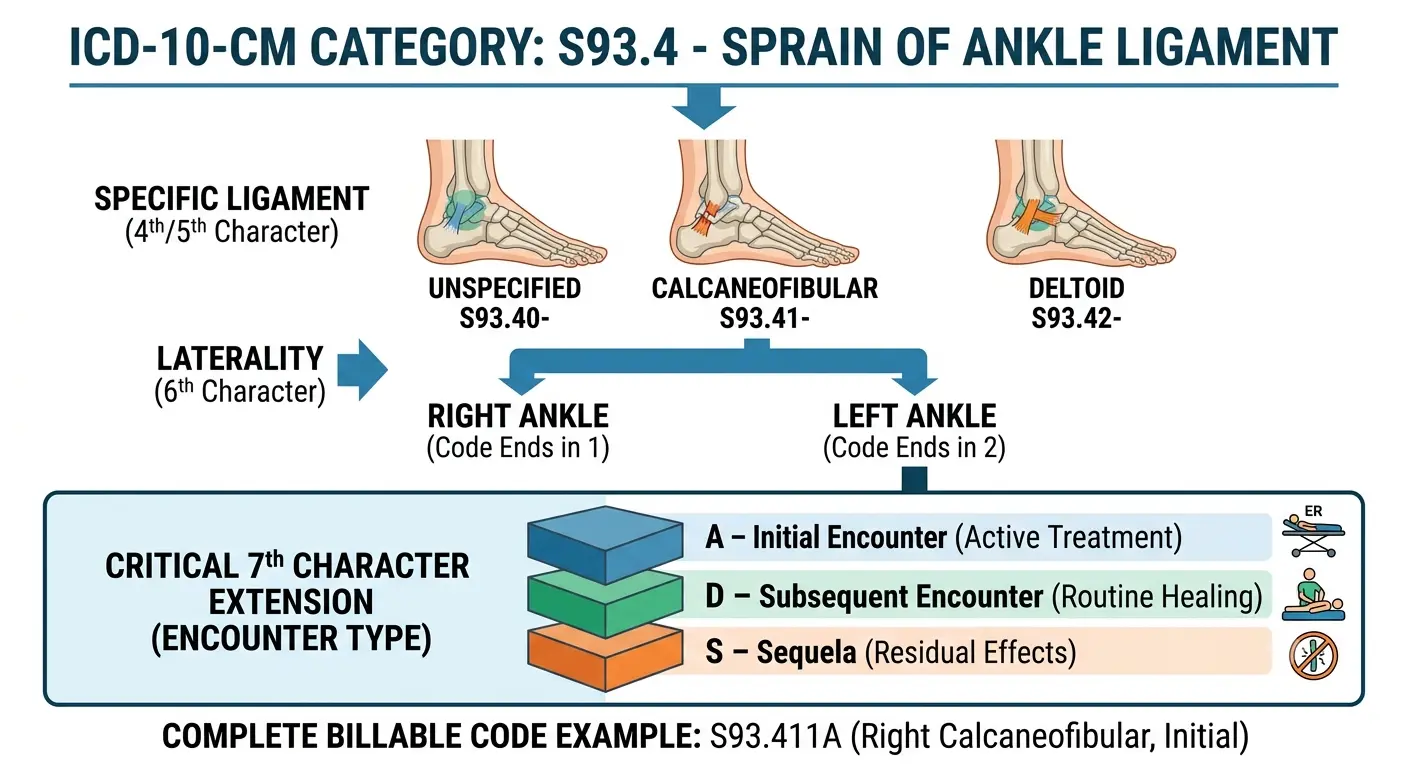
The ICD-10-CM S93.4- code family is used to report ankle ligament sprains. These codes identify three critical billing elements:
- The injured ligament
- The affected side
- The episode of care
Every claim submitted for an ankle sprain must include the complete code with the correct 7th character. Missing characters or incorrect laterality are among the most common reasons injury claims fail payer edits.
The FY2026 ICD-10-CM code set became effective on October 1, 2025, and the ankle sprain code structure remains active without major revisions.
What Is the ICD-10 Code for an Ankle Sprain?
The general ICD-10 category for ankle sprains is S93.4-, which represents:
Sprain of ligament of ankle
This category expands into multiple code groups depending on the specific ligament involved and whether the injury affects the right ankle, left ankle, or unspecified side.
Main S93.4- Code Categories
| Ligament Injury | Right Ankle | Left Ankle | Unspecified |
|---|---|---|---|
| Unspecified ligament | S93.401- | S93.402- | S93.409- |
| Calcaneofibular ligament | S93.411- | S93.412- | S93.419- |
| Deltoid ligament | S93.421- | S93.422- | S93.429- |
| Tibiofibular ligament | S93.431- | S93.432- | S93.439- |
| Other ligament | S93.491- | S93.492- | S93.499- |
Each code must include a 7th character to become billable.
Right Ankle Sprain ICD-10 Code
The most frequently reported right ankle sprain diagnosis is:
S93.401A – Sprain of unspecified ligament of right ankle, initial encounter
Additional encounter extensions include:
- S93.401D – Subsequent encounter
- S93.401S – Sequela
When the provider documents a specific ligament injury, the unspecified code should not be used.
Left Ankle Sprain ICD-10 Code
For the left ankle, the primary unspecified ligament code is:
S93.402A – Sprain of unspecified ligament of left ankle, initial encounter
Other encounter versions include:
- S93.402D – Subsequent encounter
- S93.402S – Sequela
Billing teams must ensure the laterality documented in the clinical note matches the diagnosis code and procedure modifiers.
How to Code Bilateral Ankle Sprains
ICD-10-CM does not provide a single bilateral ankle sprain code. When both ankles are injured, coders must report separate diagnosis codes for each side.
Example:
- S93.401A – Right ankle sprain
- S93.402A – Left ankle sprain
Using unspecified laterality codes to represent bilateral injuries is considered incorrect coding practice.
Ligament-Specific Ankle Sprain Codes
Detailed clinical documentation allows coders to report more precise ligament injuries.
Calcaneofibular Ligament Sprain
This ligament injury uses the S93.41- family.
Example:
- S93.411A – Right calcaneofibular ligament sprain
Deltoid Ligament Sprain
Medial ankle ligament injuries use the S93.42- series.
Example:
- S93.421A – Right deltoid ligament sprain
High Ankle Sprain ICD-10 Code
High ankle sprains involve the syndesmotic ligaments and use the S93.43- category.
Example:
- S93.431A – Sprain of tibiofibular ligament of right ankle
High ankle sprains often require extended healing periods and may involve prolonged rehabilitation and imaging follow-up.
ATFL Sprain ICD-10 Code
The anterior talofibular ligament (ATFL) is the most commonly injured ankle ligament during inversion injuries.
ICD-10-CM classifies ATFL injuries under:
- S93.491- – Right ankle
- S93.492- – Left ankle
Example:
- S93.491A – Sprain of other ligament of right ankle, initial encounter
Understanding the 7th Character in Ankle Sprain Coding
Every S93.4- diagnosis requires a 7th character extension.
7th Character A – Initial Encounter
Character A represents active treatment.
This includes:
- Initial evaluations
- Emergency room visits
- New treatment plans
- Specialist consultations involving active care
Example:
- S93.401A
7th Character D – Subsequent Encounter
Character D represents routine healing care after active treatment has started.
Common examples include:
- Follow-up evaluations
- Brace adjustments
- Rehabilitation monitoring
- Progress checks
Example:
- S93.401D
One of the most common billing errors occurs when practices continue using “A” on every visit instead of transitioning to “D.”
7th Character S – Sequela
Character S reports complications or residual effects that occur after healing.
Examples include:
- Chronic instability
- Persistent pain
- Post-traumatic weakness
Example:
- S93.401S
The residual condition is listed first, followed by the injury code with the sequela extension.
Common ICD-10 Coding Confusion with Ankle Sprains
Ankle Sprain vs Foot Sprain
- S93.4- = ankle ligament injuries
- S93.6- = foot ligament injuries
Providers must clearly document the injury location.
Sprain vs Strain
A sprain involves ligaments, while a strain affects muscles or tendons.
- Sprains = S93.4-
- Strains = S96-
Incorrect terminology can completely change the diagnosis category.
Acute Sprain vs Chronic Instability
Repeated ankle injuries may eventually progress to chronic instability conditions.
These cases frequently shift toward:
- M24.27- – Ligament instability
Surgical repair claims are often built around chronic instability diagnoses instead of acute sprain codes.
Documentation Requirements for Ankle Sprain Claims
Strong clinical documentation protects practices from denials and medical necessity disputes.
Essential Documentation Elements
Providers should document:
- Injury mechanism
- Affected ligament
- Right or left ankle
- Severity grade
- Episode of care
- Physical examination findings
- Imaging interpretation
- Functional limitations
Detailed documentation also supports DME claims, imaging services, and therapy referrals.
CPT Codes Commonly Billed with Ankle Sprain ICD-10 Codes
Ankle sprain claims often involve E/M services, imaging, splinting, and orthotic devices.
Frequently Used CPT and HCPCS Codes
| CPT/HCPCS | Description |
|---|---|
| 99202–99215 | Office evaluation and management |
| 73600 | Ankle X-ray, 2 views |
| 73610 | Complete ankle X-ray |
| 76881 | Complete extremity ultrasound |
| 29540 | Ankle strapping |
| 29515 | Short leg splint application |
| L1902 | Off-the-shelf ankle orthosis |
| L4360 | Pneumatic walking boot |
Imaging claims should include clinical findings supporting medical necessity, especially under payer policies tied to the Ottawa Ankle Rules.
Modifiers Used with Ankle Sprain Claims
RT and LT Modifiers
These modifiers identify the affected side on:
- Imaging claims
- Durable medical equipment
- Splinting procedures
The modifier side must match the diagnosis laterality.
Example:
- Right ankle diagnosis = RT modifier
Modifier 25
Modifier 25 is used when a significant E/M service occurs separately from a procedure performed on the same day.
Common examples include:
- Evaluation plus splint application
- Evaluation plus strapping
Most Common Ankle Sprain Billing Denials
Missing 7th Character
Incomplete diagnosis codes immediately fail clearinghouse edits.
Incorrect:
- S93.401
Correct:
- S93.401A
Improper Encounter Extension
Using “A” repeatedly on follow-up visits frequently triggers payer scrutiny.
Practices should establish workflows that automatically transition healing visits to “D.”
Laterality Mismatch Errors
Denials occur when diagnosis laterality conflicts with RT/LT procedure modifiers.
Example:
- Left ankle diagnosis paired with RT modifier
Insufficient Imaging Documentation
X-ray claims often fail when the chart lacks:
- Weight-bearing limitations
- Swelling documentation
- Bone tenderness findings
Detailed examination notes help justify imaging services.
FY2026 ICD-10 Updates for Ankle Sprain Codes
The FY2026 ICD-10-CM update preserved the existing ankle sprain structure.
No major revisions were made to:
- Ligament categories
- Laterality indicators
- 7th character requirements
Practices should still review yearly updates to ensure coding accuracy and compliance with payer policies.
Best Practices for Clean Ankle Sprain Claims
Healthcare organizations can reduce denials by implementing strong coding workflows.
Recommended Billing Safeguards
- Require mandatory 7th character selection
- Verify laterality consistency
- Audit encounter progression
- Confirm documentation supports imaging
- Review modifier usage before submission
Accurate ankle sprain coding improves reimbursement accuracy, reduces payer audits, and strengthens overall revenue cycle performance.
Frequently Asked Questions About Ankle Sprain ICD-10 Codes
What is the ICD-10 code for a right ankle sprain?
The most common right ankle sprain diagnosis is S93.401A for the initial encounter.
What is the ICD-10 code for a left ankle sprain?
The standard left ankle sprain code is S93.402A for active treatment.
What is the ICD-10 code for a high ankle sprain?
High ankle sprains use the S93.43- code family involving tibiofibular ligament injuries.
What does the 7th character mean in ankle sprain coding?
- A = Initial encounter
- D = Subsequent encounter
- S = Sequela
Can ankle sprain claims use aftercare Z codes?
No. Injury claims continue using the original S93.4- code with the appropriate healing-stage extension.
What is the ICD-10 code for an ATFL sprain?
ATFL injuries use the “other ligament” category:
- S93.491- for right ankle
- S93.492- for left ankle