Choosing the right electronic health record (EHR) can have a major impact on clinical workflows, billing, patient communication, and long-term operating costs. Two widely recognized platforms are eClinicalWorks and Epic, but they are designed for different healthcare environments.
eClinicalWorks is strongly focused on ambulatory and specialty practices, while Epic is better known for hospitals, health systems, and academic medical centers. This guide compares the two platforms based on features, pricing, AI, implementation, interoperability, and overall suitability.
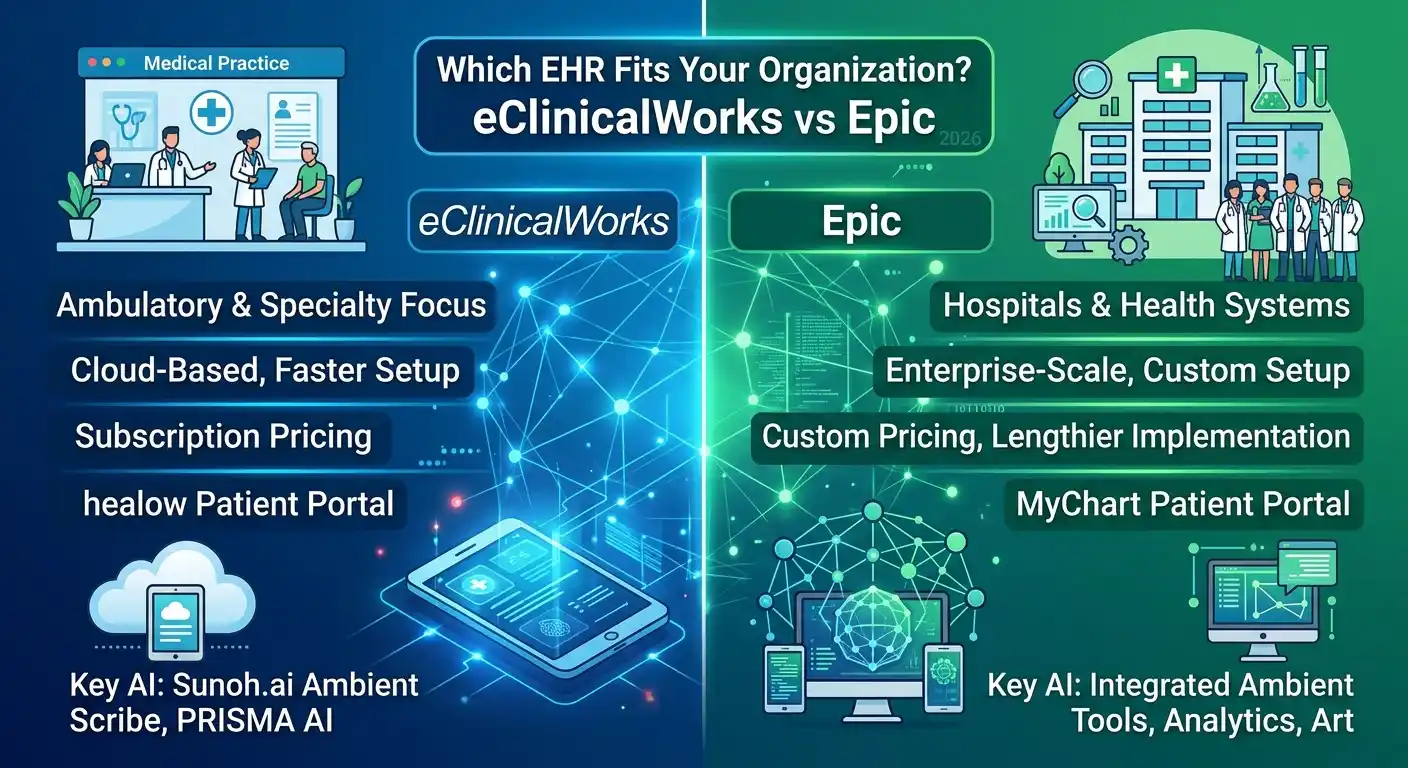
eClinicalWorks vs Epic at a Glance
| Category | eClinicalWorks | Epic |
|---|---|---|
| Best for | Outpatient and specialty practices | Hospitals and health systems |
| Deployment | Primarily cloud-based | Enterprise-scale deployment |
| Pricing | Subscription-based | Customized pricing |
| Implementation | Generally faster | Often lengthy |
| Patient portal | healow | MyChart |
| AI | Sunoh.ai, PRISMA AI, healow Genie | Ambient tools, Art, Emmie |
| Main strength | Flexibility and affordability | Enterprise integration |
What Is eClinicalWorks?
eClinicalWorks is a cloud-based EHR and practice management platform founded in 1999. It combines clinical documentation, scheduling, electronic prescribing, billing, patient engagement, telehealth, and reporting.
Its healow ecosystem provides patients with tools for appointments, messaging, prescription requests, health information, and virtual care.
The platform is particularly suitable for independent physicians, specialty groups, and multi-location outpatient practices that want a relatively quick implementation without the infrastructure associated with a large hospital EHR.
eClinicalWorks also continues to expand its artificial intelligence capabilities. Sunoh.ai provides ambient documentation, while tools such as PRISMA AI, Image AI, and healow Genie target record review, document processing, and patient communication.
What Is Epic?
Epic Systems is one of the largest EHR vendors serving hospitals and integrated healthcare organizations. Its platform supports inpatient and outpatient care, specialty departments, revenue cycle operations, analytics, research, and patient engagement.
Major Epic products include EpicCare, MyChart, Care Everywhere, Beacon, and Cosmos.
Epic’s biggest advantage is its ability to connect different departments and facilities through a common enterprise environment. This makes it particularly attractive to health systems that want standardized workflows and a unified patient record.
Features and Usability
Both systems cover core EHR functions, including clinical documentation, scheduling, prescriptions, patient communication, reporting, and billing.
The difference is mainly scale.
eClinicalWorks gives smaller practices flexibility to configure outpatient workflows. Epic offers deeper enterprise functionality but may require more training and administrative resources.
For a small practice, Epic’s extensive feature set may be unnecessary. For a large health system, eClinicalWorks may not provide the same enterprise depth.
Pricing and Implementation
Pricing is another major difference.
eClinicalWorks offers subscription-based options, with publicly discussed plans generally costing several hundred dollars per provider each month depending on the services selected. Additional RCM, integrations, and other services can affect the final cost.
Epic does not publish a standard price list. Costs are typically customized according to organization size, modules, implementation requirements, hosting, interfaces, training, and support.
Implementation is also different. A smaller eClinicalWorks practice can often move to the cloud in a shorter timeframe. Epic implementations can take many months or longer because they often involve multiple departments, facilities, integrations, and extensive training.
Healthcare organizations should compare the three- to five-year total cost of ownership, not just the initial subscription price.
AI Capabilities
AI is becoming an important part of modern EHR systems.
eClinicalWorks has focused on practical automation. Sunoh.ai helps generate clinical documentation from conversations, while other AI tools support document processing and patient communication.
Epic has taken a broader enterprise approach, incorporating AI into documentation, clinical workflows, patient communication, and research.
Neither platform is automatically better. A small clinic may value an easy-to-use AI scribe, while a large health system may prefer AI integrated across its entire EHR environment.
Interoperability
Both vendors support modern health information exchange and interoperability standards.
Epic has a major advantage through its large installed base and Care Everywhere, which helps participating organizations exchange patient information.
eClinicalWorks also supports interoperability for ambulatory practices and can connect providers to external healthcare networks.
When evaluating either system, organizations should ask about FHIR APIs, external record exchange, data migration, patient matching, and data export if the organization eventually changes vendors.
Which One Should You Choose?
Choose eClinicalWorks if you:
- Run an independent or specialty practice
- Want a cloud-focused EHR
- Need faster implementation
- Prefer predictable subscription costs
- Have limited internal IT resources
Consider Epic if you:
- Operate a hospital or large health system
- Need enterprise-wide standardization
- Require extensive specialty functionality
- Have significant IT and implementation resources
- Need advanced analytics and research capabilities
Final Verdict
There is no universal winner between eClinicalWorks and Epic.
eClinicalWorks is generally the more practical choice for independent and ambulatory practices that prioritize flexibility, speed, and cost control. Epic is generally better suited to hospitals and large health systems that need extensive integration and enterprise-level capabilities.
Before signing a contract, compare real workflows, implementation costs, AI features, interoperability, support, security, and data-export terms. The best EHR is ultimately the one that fits your organization’s size, budget, staff, and long-term goals.