
HCPCS code J9332 is used to report efgartigimod alfa-fcab (Vyvgart) for intravenous treatment of generalized myasthenia gravis (gMG). Because the code represents the drug itself rather than the infusion service, accurate unit calculation, drug sourcing, documentation, and modifier use are essential for clean claims.
For practices treating patients with Vyvgart, the biggest billing issues usually involve incorrect units, confusion between IV and subcutaneous products, drug wastage, prior authorization, and payer-specific site-of-care requirements.
What Does HCPCS Code J9332 Represent?
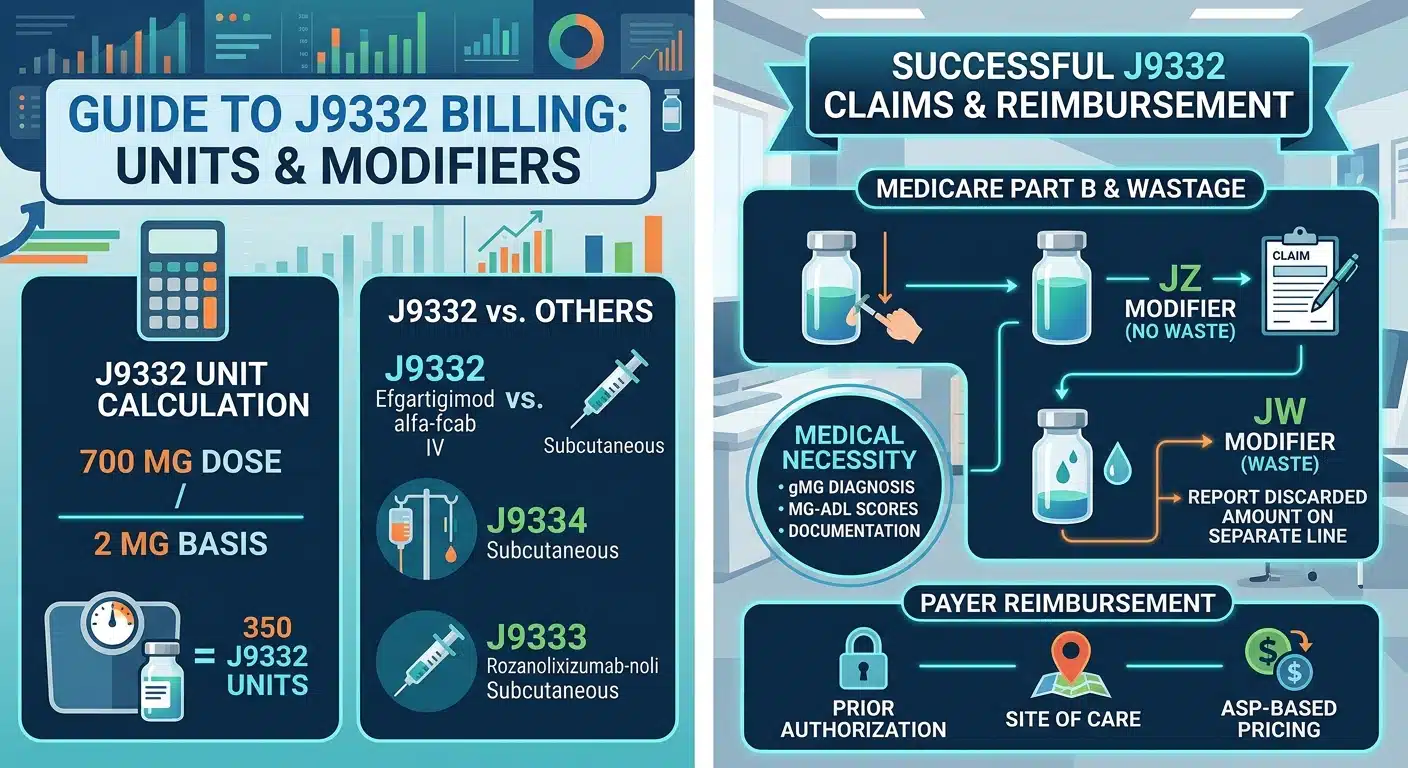
J9332 identifies efgartigimod alfa-fcab, 2 mg. The code is reported according to the dosage specified in its HCPCS descriptor, so the amount administered must be converted into billing units before the claim is submitted.
The standard weight-based IV dosing calculation is:
Billing units = administered milligrams ÷ 2
For example, a 700 mg dose is reported as 350 units of J9332.
J9332 should not be confused with the administration service. The drug and the infusion service are separate components of the claim, and the appropriate administration CPT code depends on the clinical service and payer billing policy.
J9332 vs. Other FcRn Drug Codes
Route and formulation are important when selecting the correct HCPCS code.
| Code | Product | Route | Billing Basis |
|---|---|---|---|
| J9332 | Efgartigimod alfa-fcab (Vyvgart) | IV | 2 mg |
| J9334 | Efgartigimod alfa + hyaluronidase-qvfc (Vyvgart Hytrulo) | Subcutaneous | 2 mg |
| J9333 | Rozanolixizumab-noli (Rystiggo) | Subcutaneous | 1 mg |
These products share a therapeutic class but are not interchangeable for billing. A charge-master or electronic ordering system that maps the wrong product to J9332 can create avoidable claim denials.
How Should J9332 Units Be Calculated?
Unit calculation should begin with the actual dose administered, not the number of vials purchased.
For example, a patient receiving 700 mg receives:
700 mg ÷ 2 mg = 350 units
The medical record should support the patient’s weight, calculated dose, actual amount administered, and any remaining medication that was discarded.
CMS instructs providers to report drug units according to the HCPCS dosage definition and to ensure that billed units do not exceed applicable payment or utilization limits. (CMS)
JW and JZ Modifiers for Drug Waste
Single-dose vial billing makes wastage documentation especially important.
When part of an eligible single-dose container is discarded, modifier JW is reported on a separate claim line for the discarded amount. When there is no discarded amount, modifier JZ is used to indicate zero waste. CMS requires these modifiers for applicable separately payable single-dose drugs under Medicare Part B. (CMS)
For example, if 700 mg is administered from 400 mg vials and 100 mg is discarded, the administered amount and discarded amount should be calculated separately in J9332 billing units, with the waste reported using JW when Medicare’s policy applies.
Documentation should clearly show the administered dose, discarded quantity, and vial strength. CMS also states that discarded medication must actually be discarded and cannot simply be transferred for use by another patient. (CMS)
Medical Necessity and Diagnosis Coding
J9332 is primarily associated with treatment of generalized myasthenia gravis. The diagnosis reported on the claim should accurately reflect the patient’s documented clinical condition.
Common ICD-10-CM options include:
- G70.00 – Myasthenia gravis without (acute) exacerbation
- G70.01 – Myasthenia gravis with (acute) exacerbation
The medical record should support the diagnosis, treatment rationale, functional impact, and response to therapy. Payers may also require clinical measures such as MG-ADL or QMG scores as part of authorization or continuation review.
What Determines the Cost of J9332?
Medicare Part B drug reimbursement can change by quarter. Providers should use the current CMS Medicare Part B Drug Payment Limit File rather than relying on an old fee schedule or a historical reimbursement figure. CMS publishes updated 2026 payment-limit files, including January, April, and July releases. (CMS)
Commercial reimbursement is different. Contracts may use ASP-based, AWP-based, or other negotiated methodologies. Prior authorization, specialty-drug requirements, and site-of-care policies can also affect the final payment.
Three Common J9332 Billing Scenarios
Scenario 1: New IV treatment
A patient with documented gMG begins an IV Vyvgart treatment cycle. The practice verifies authorization, calculates the dose from the patient’s weight, reports J9332 in the correct units, and bills the applicable infusion administration service separately.
Scenario 2: Repeat treatment cycle
Before another cycle, the provider documents the patient’s response and confirms that payer requirements for continued treatment have been met. Authorization and treatment timing should be checked before scheduling the next infusion.
Scenario 3: Partial-vial waste
A weight-based dose does not use an entire vial. The administered quantity is reported on the drug line, while eligible discarded medication is reported separately with JW under applicable Medicare rules. If there is no waste, JZ is used when required. (CMS)
J9332 Billing Checklist
Before submitting a J9332 claim, verify:
- The correct IV product is being billed.
- Units are calculated from milligrams using the 2 mg billing basis.
- The diagnosis and medical necessity documentation support treatment.
- Authorization and site-of-care requirements have been satisfied.
- JW or JZ is reported when applicable.
- The drug acquisition method is correctly identified.
- Current CMS pricing and payer contract rules are used.
Accurate J9332 billing ultimately depends on connecting the clinical record, dose calculation, drug acquisition, modifiers, authorization, and claim data. A consistent review process can prevent the unit, wastage, route, and reimbursement errors that commonly delay payment for high-cost biologic therapy.