
Diabetic nephropathy is one of the most common long-term complications of diabetes mellitus and a major contributor to chronic kidney disease (CKD) worldwide. As kidney damage progresses, patients often require ongoing monitoring, specialist care, and, in severe cases, dialysis or kidney transplantation. Because diabetic kidney disease significantly affects patient management and reimbursement, selecting the correct ICD-10-CM diagnosis code is essential for healthcare providers, medical coders, and billing professionals.
Many coding errors occur because diabetic nephropathy and diabetic chronic kidney disease are often confused. While these conditions are closely related, they are not always coded the same way. ICD-10-CM provides combination codes that link diabetes with its renal complications, but the correct code depends entirely on the provider’s documentation.
This comprehensive guide explains the ICD-10-CM codes used for diabetic nephropathy, how to distinguish between diabetic nephropathy and diabetic CKD, when additional CKD stage codes are required, documentation standards, sequencing rules, common billing mistakes, and coding tips that help improve claim accuracy.
Understanding Diabetic Nephropathy
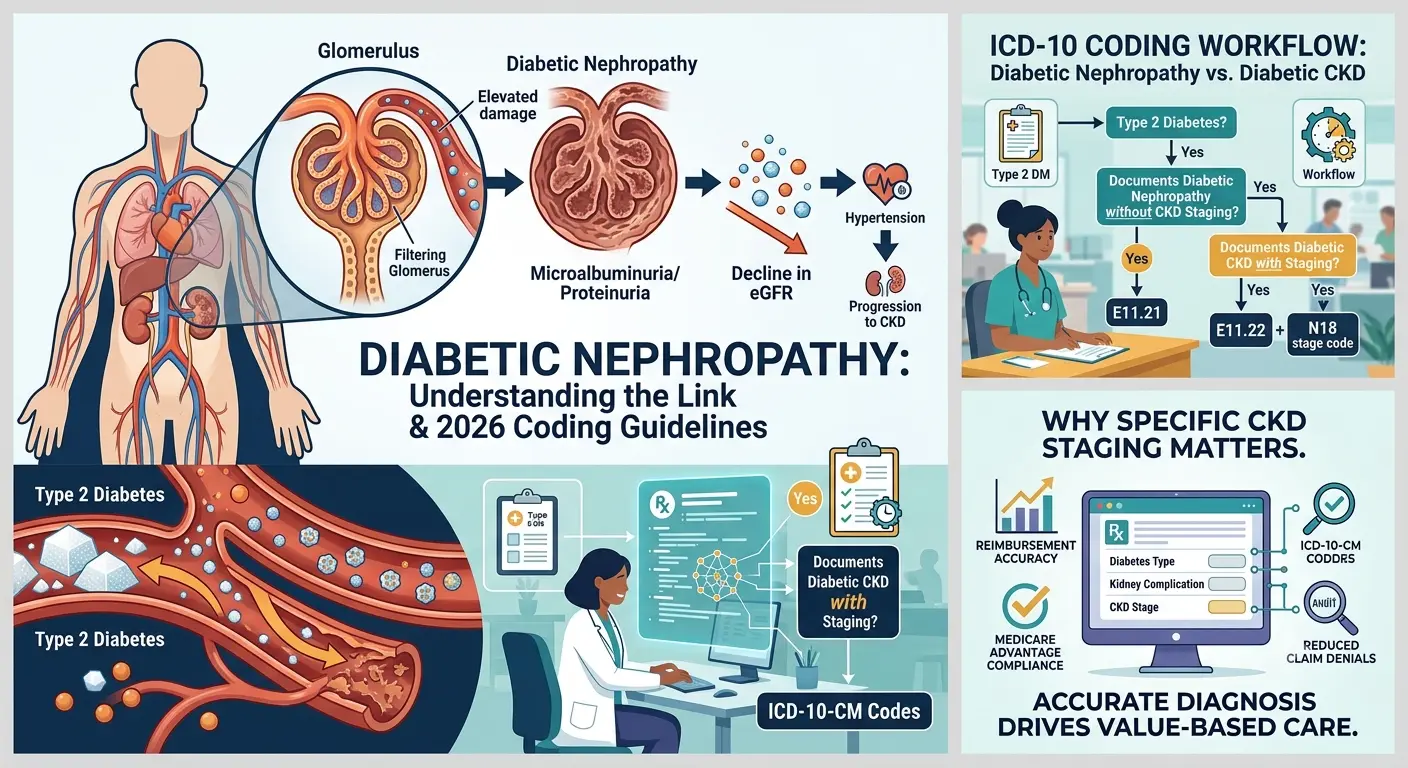
Diabetic nephropathy is kidney damage caused by long-standing diabetes mellitus. Elevated blood glucose levels gradually damage the kidneys’ filtering units (glomeruli), reducing their ability to remove waste products and excess fluid from the bloodstream.
During the early stages, patients may not experience noticeable symptoms. Laboratory findings such as microalbuminuria or proteinuria often provide the first indication of kidney involvement. As the disease advances, renal function declines, eventually leading to chronic kidney disease or end-stage renal disease (ESRD).
Common clinical findings include:
- Persistent albuminuria
- Proteinuria
- Declining estimated glomerular filtration rate (eGFR)
- Elevated serum creatinine
- Hypertension
- Progressive CKD
Since diabetic nephropathy develops gradually, early diagnosis and accurate documentation play a critical role in both patient care and medical coding.
ICD-10 Code for Diabetic Nephropathy
For patients diagnosed with Type 2 diabetes mellitus and diabetic nephropathy, the primary ICD-10-CM code is:
| ICD-10 Code | Description | Billable |
|---|---|---|
| E11.21 | Type 2 diabetes mellitus with diabetic nephropathy | Yes |
This combination code identifies that the patient’s kidney disease is a complication of Type 2 diabetes mellitus.
Unlike older coding systems that required separate diabetes and kidney disease diagnoses, ICD-10-CM combines both conditions into one diagnosis code whenever an established diabetic complication exists.
When Should E11.21 Be Reported?
Code E11.21 should be assigned when the medical record documents diabetic nephropathy but does not identify chronic kidney disease by stage.
Typical provider documentation may include:
- Diabetic nephropathy
- Diabetic renal disease
- Diabetic glomerulosclerosis
- Kimmelstiel-Wilson disease
- Intercapillary glomerulosclerosis
If none of the documentation indicates chronic kidney disease staging, E11.21 is generally the appropriate diagnosis code.
Conditions Included Under E11.21
Several renal conditions are indexed to the same ICD-10-CM code because they represent diabetic damage to the kidneys.
Examples include:
- Diabetic nephropathy
- Kimmelstiel-Wilson syndrome
- Diabetic intercapillary glomerulosclerosis
- Diabetic intracapillary glomerulonephrosis
Although these conditions have different pathological descriptions, ICD-10-CM classifies them under the same combination diagnosis when associated with Type 2 diabetes.
When E11.21 Is NOT the Correct Code
One of the most frequent coding errors occurs when E11.21 is reported even though the provider documents chronic kidney disease.
If documentation includes statements such as:
- Diabetic CKD
- CKD Stage 2
- CKD Stage 3a
- CKD Stage 3b
- CKD Stage 4
- CKD Stage 5
- End-stage renal disease
then E11.21 should not be assigned.
Instead, ICD-10-CM directs coders to use the diabetic CKD combination code along with the appropriate CKD stage code.
Complete Type 2 Diabetes Kidney Complication Codes
ICD-10-CM groups kidney complications of Type 2 diabetes within category E11.2.
| Code | Description | Billable |
|---|---|---|
| E11.2 | Type 2 diabetes mellitus with kidney complications | No |
| E11.21 | Type 2 diabetes mellitus with diabetic nephropathy | Yes |
| E11.22 | Type 2 diabetes mellitus with diabetic chronic kidney disease | Yes |
| E11.29 | Type 2 diabetes mellitus with other diabetic kidney complications | Yes |
Notice that E11.2 serves only as a category heading and cannot be submitted on insurance claims.
Only the more specific child codes are considered billable.
Understanding E11.22: Diabetic Chronic Kidney Disease
When a provider documents chronic kidney disease related to diabetes, ICD-10-CM requires a different combination code.
| ICD-10 Code | Description |
|---|---|
| E11.22 | Type 2 diabetes mellitus with diabetic chronic kidney disease |
Unlike E11.21, this code cannot stand alone.
An additional ICD-10-CM code from category N18 must always be assigned to identify the stage of chronic kidney disease.
This requirement allows payers to determine the severity of renal impairment and supports appropriate reimbursement.
CKD Stage Codes Used With E11.22
The following CKD stage codes are reported in addition to E11.22 whenever chronic kidney disease is documented.
| ICD-10 Code | CKD Stage |
|---|---|
| N18.1 | Stage 1 CKD |
| N18.2 | Stage 2 CKD |
| N18.30 | Stage 3, unspecified |
| N18.31 | Stage 3a |
| N18.32 | Stage 3b |
| N18.4 | Stage 4 |
| N18.5 | Stage 5 |
| N18.6 | End-stage renal disease |
| N18.9 | CKD, unspecified |
These stage codes provide important clinical detail and are mandatory whenever E11.22 is reported.
E11.21 vs. E11.22: What’s the Difference?
Although both diagnosis codes describe diabetic kidney complications, they represent different clinical scenarios.
| Feature | E11.21 | E11.22 |
|---|---|---|
| Diagnosis | Diabetic nephropathy | Diabetic chronic kidney disease |
| CKD documented | No | Yes |
| CKD stage required | No | Yes |
| Requires N18 code | No | Yes |
| Combination code | Yes | Yes |
The deciding factor is simple:
- Use E11.21 when diabetic nephropathy is documented without CKD staging.
- Use E11.22 when chronic kidney disease is documented and assign the appropriate N18 stage code.
Examples of Correct Coding
Example 1
Provider Documentation
Type 2 diabetes mellitus with diabetic nephropathy.
Coding
- E11.21
Example 2
Provider Documentation
Type 2 diabetes mellitus with CKD stage 3b caused by diabetes.
Coding
- E11.22
- N18.32
Example 3
Provider Documentation
Type 2 diabetes with ESRD receiving maintenance dialysis.
Coding
- E11.22
- N18.6
- Z99.2 (Dependence on renal dialysis)
Why Accurate Coding Matters
Selecting the correct diagnosis code affects much more than claim submission.
Accurate ICD-10-CM coding helps:
- Support medical necessity
- Reduce claim denials
- Improve reimbursement accuracy
- Reflect disease severity
- Improve quality reporting
- Support CMS risk adjustment
- Reduce audit risk
- Maintain compliance with ICD-10-CM Official Guidelines
Coding diabetic kidney disease correctly also provides a more accurate picture of the patient’s overall health status, which is increasingly important in value-based healthcare models.
Part 2
ICD-10-CM Coding Guidelines for Diabetic Nephropathy
Selecting the correct ICD-10-CM code involves more than identifying the diagnosis. Coders must also understand the official coding guidelines, sequencing instructions, and documentation standards that apply to diabetic kidney disease. Following these rules helps ensure claims are coded accurately and reduces the likelihood of payer denials.
The ICD-10-CM “With” Convention Explained
One of the most important concepts in diabetes coding is the “with” convention found in the ICD-10-CM Alphabetic Index.
Under the main term Diabetes, many complications—including chronic kidney disease—appear beneath the subterm “with.” According to the Official ICD-10-CM Guidelines, when diabetes and one of these listed complications are documented together, a causal relationship is generally presumed unless the provider clearly states another cause.
Example
Provider Documentation
- Type 2 diabetes mellitus
- Chronic kidney disease stage 3
Because chronic kidney disease is indexed under “Diabetes with”, the appropriate combination code is:
- E11.22
- N18.30, N18.31, or N18.32, depending on the documented stage
Even if the provider does not explicitly write “CKD due to diabetes,” the combination code is appropriate unless documentation clearly attributes the kidney disease to another condition.
When the Presumed Relationship Does Not Apply
The automatic relationship should not be assumed if the provider documents that the kidney disease has another cause.
Examples include:
- CKD caused by polycystic kidney disease
- CKD secondary to lupus nephritis
- CKD due to congenital renal abnormalities
- Kidney disease resulting from obstructive uropathy
- CKD caused by long-standing glomerulonephritis
In these situations, coders should follow the provider’s documented diagnosis and assign codes accordingly rather than automatically linking the CKD to diabetes.
When documentation is unclear, a provider query may be necessary.
Why CKD Stage Documentation Is So Important
Unlike diabetic nephropathy, chronic kidney disease requires severity reporting.
The N18 category communicates the patient’s stage of kidney impairment, which influences:
- Treatment decisions
- Medical necessity
- Risk adjustment
- Reimbursement
- Disease severity reporting
- Quality metrics
Without an N18 stage code, the payer cannot determine how advanced the kidney disease is.
Understanding CKD Stages
CKD is divided into stages based primarily on estimated glomerular filtration rate (eGFR).
| CKD Stage | Typical eGFR |
|---|---|
| Stage 1 | 90 mL/min/1.73m² or higher with kidney damage |
| Stage 2 | 60–89 |
| Stage 3a | 45–59 |
| Stage 3b | 30–44 |
| Stage 4 | 15–29 |
| Stage 5 | Less than 15 |
| ESRD | Kidney failure requiring long-term dialysis |
Although laboratory values help determine severity clinically, ICD-10-CM coding should follow the provider’s documented diagnosis rather than assigning a stage based solely on lab results unless allowed by facility policy.
Sequencing Rules for Diabetic CKD
Correct sequencing is just as important as selecting the right diagnosis code.
For diabetic chronic kidney disease, ICD-10-CM follows an etiology/manifestation coding convention.
The diabetes code is reported first because it represents the underlying disease.
The CKD stage code follows because it identifies the manifestation.
Correct Sequence
- E11.22
- N18.31
Incorrect Sequence
- N18.31
- E11.22
Reversing this order may result in claim edits or reimbursement delays.
Coding Patients Receiving Dialysis
Patients with end-stage renal disease frequently receive chronic dialysis.
When documentation confirms dialysis dependence, an additional diagnosis code should be reported.
Typical coding includes:
- E11.22
- N18.6
- Z99.2
The Z99.2 code communicates that the patient depends on renal dialysis for survival.
Coding Diabetes, Hypertension, and CKD Together
Many patients with diabetic nephropathy also have hypertension.
ICD-10-CM presumes a relationship between hypertension and chronic kidney disease unless documentation clearly states the two conditions are unrelated.
Because of this, hypertension is often reported using a code from category I12 rather than essential hypertension (I10).
Common Coding Combination
For a patient with:
- Type 2 diabetes
- Chronic kidney disease stage 3b
- Hypertension
The coding may include:
- E11.22
- I12.9
- N18.32
If the patient has stage 5 CKD or ESRD with hypertension, I12.0 is generally assigned instead of I12.9.
Always review the current ICD-10-CM guidelines and payer-specific policies before assigning hypertension codes.
Documentation Needed for E11.21
To support E11.21, provider documentation should clearly establish diabetic nephropathy.
Helpful documentation includes:
- Diagnosis of diabetic nephropathy
- Diabetes type
- Evidence of renal involvement
- Clinical assessment
- Treatment plan
- Provider signature
Importantly, there should be no documented CKD stage, or coding will likely shift to E11.22.
Documentation Needed for E11.22
Because E11.22 represents diabetic chronic kidney disease, documentation requirements are more detailed.
The medical record should include:
- Diabetes diagnosis
- CKD diagnosis
- CKD stage
- Provider assessment
- Management plan
- Current medications
- Laboratory findings supporting clinical assessment
- Provider authentication
Incomplete documentation frequently leads to coding uncertainty and delayed reimbursement.
Coding Across All Diabetes Categories
Although Type 2 diabetes accounts for the majority of diabetic nephropathy claims, ICD-10-CM includes kidney complication codes for every major diabetes category.
| Diabetes Category | Nephropathy | Diabetic CKD | Other Kidney Complication |
|---|---|---|---|
| E08 | E08.21 | E08.22 | E08.29 |
| E09 | E09.21 | E09.22 | E09.29 |
| E10 | E10.21 | E10.22 | E10.29 |
| E11 | E11.21 | E11.22 | E11.29 |
| E13 | E13.21 | E13.22 | E13.29 |
Notice that every diabetes category follows the same pattern.
Only the first three characters change according to the diabetes type.
Choosing the Correct Diabetes Category
Before assigning a kidney complication code, identify the patient’s diabetes classification.
E08
Use when diabetes develops as a result of another medical condition.
Examples include:
- Chronic pancreatitis
- Pancreatic cancer
- Cystic fibrosis
E09
Used for diabetes caused by medications or chemicals.
Examples include:
- Long-term corticosteroid therapy
- Drug-induced hyperglycemia
- Chemical exposure
Additional external cause coding may also be required.
E10
Assigned for Type 1 diabetes mellitus.
Even though Type 1 diabetes is less common than Type 2, diabetic nephropathy can still develop after years of disease progression.
E11
Used for Type 2 diabetes mellitus.
This category accounts for the vast majority of diabetic nephropathy claims submitted by physician practices.
E13
Assigned when diabetes falls into another specified category.
Examples include:
- Post-pancreatectomy diabetes
- Secondary diabetes not classified elsewhere
- Other specified forms documented by the provider
Real-World Coding Examples
Scenario 1
Documentation
Type 1 diabetes with diabetic nephropathy.
Coding
- E10.21
Scenario 2
Documentation
Drug-induced diabetes with CKD stage 4.
Coding
- E09.22
- N18.4
Additional drug-related coding may also be necessary.
Scenario 3
Documentation
Diabetes secondary to chronic pancreatitis with CKD stage 2.
Coding
- Code for chronic pancreatitis
- E08.22
- N18.2
Scenario 4
Documentation
Other specified diabetes with diabetic nephropathy.
Coding
- E13.21
Common Documentation Problems
Medical coders frequently encounter records that lack sufficient detail.
Common issues include:
- Diabetes type not documented
- CKD stage omitted
- Kidney complication not specified
- Conflicting provider notes
- Missing assessment
- Incomplete progress notes
- Unclear relationship between diagnoses
Whenever documentation prevents accurate code assignment, querying the provider is the best practice.
Tips to Improve Coding Accuracy
Organizations can improve coding quality by following several best practices:
- Review provider documentation before assigning diagnosis codes.
- Confirm the diabetes type.
- Verify whether CKD is documented.
- Capture the most specific CKD stage available.
- Report combination codes whenever appropriate.
- Follow ICD-10-CM sequencing instructions.
- Review annual coding updates.
- Perform routine internal coding audits.
- Educate providers on documentation requirements.
Strong collaboration between providers, coders, and clinical documentation improvement (CDI) teams helps reduce errors and supports compliant billing.
CPT Codes Commonly Reported With Diabetic Nephropathy
Diagnosis codes explain why a patient is receiving care, while CPT codes identify what services were performed. Correctly pairing ICD-10-CM and CPT codes helps establish medical necessity and supports accurate reimbursement.
Although CPT code selection depends on the services provided during the encounter, several procedures are frequently associated with patients who have diabetic nephropathy or diabetic chronic kidney disease.
| CPT Code | Description | Common Use |
|---|---|---|
| 82043 | Urine albumin, quantitative | Detecting or monitoring albuminuria |
| 82570 | Creatinine, urine | Used with urine albumin testing to calculate the albumin-to-creatinine ratio (ACR) |
| 82565 | Creatinine, blood | Evaluating kidney function and estimating eGFR |
| 80053 | Comprehensive metabolic panel | Monitoring kidney function, electrolytes, and metabolic status |
| 81001 | Urinalysis with microscopy | Assessing proteinuria, hematuria, or other urinary abnormalities |
| 99202–99205 | New patient office visits | Evaluation and management services |
| 99212–99215 | Established patient office visits | Follow-up care and chronic disease management |
| 90935 | Hemodialysis procedure with physician evaluation | Hospital-based dialysis services |
| 90937 | Hemodialysis requiring repeated physician evaluations | Intensive dialysis management |
| 90960–90962 | Monthly ESRD management | Ongoing care for patients receiving dialysis |
Important: CPT coding depends on the services documented in the medical record. Always verify payer policies, National Correct Coding Initiative (NCCI) edits, and CPT reporting guidelines before claim submission.
Documentation Tips for Successful Claims
Accurate documentation is the foundation of compliant medical coding. Even when the correct ICD-10-CM code exists, incomplete documentation can result in claim denials or payment delays.
Providers should clearly document:
- Diabetes type
- Kidney complication
- CKD stage (when applicable)
- Current treatment plan
- Relevant laboratory findings
- Medication management
- Dialysis status, if applicable
- Clinical assessment and follow-up plan
Clear documentation reduces ambiguity and allows coders to assign the most specific diagnosis codes.
Medicare and CMS-HCC Risk Adjustment
Patients with diabetic kidney disease often qualify for higher clinical risk scores because these conditions indicate increased disease complexity.
For organizations participating in Medicare Advantage, Accountable Care Organizations (ACOs), or other value-based care models, accurate diagnosis coding directly affects risk adjustment.
Conditions such as:
- Diabetes with chronic complications
- Advanced CKD
- End-stage renal disease
may contribute to a patient’s risk profile when documented and coded correctly.
Because CMS updates its risk adjustment methodology periodically, coding professionals should review the current CMS-HCC model and applicable payer guidance each year.
Why Specific CKD Staging Matters
Using a nonspecific diagnosis code when a more detailed stage is documented can negatively affect both clinical reporting and reimbursement.
For example:
Instead of reporting:
- N18.9 – Chronic kidney disease, unspecified
Use the documented stage whenever available:
- N18.2
- N18.31
- N18.32
- N18.4
- N18.5
- N18.6
More specific coding better reflects the patient’s condition and supports accurate reporting.
Common Coding Mistakes to Avoid
Even experienced coders can make errors when assigning diabetic nephropathy codes. Recognizing these common pitfalls can improve claim accuracy.
1. Reporting E11.21 When CKD Is Documented
If the provider documents diabetic chronic kidney disease, E11.22—not E11.21—is generally the correct combination code, along with the appropriate N18 stage code.
2. Omitting the CKD Stage Code
Whenever E11.22 is assigned, an N18 stage code should also be reported to identify the severity of chronic kidney disease.
3. Selecting the Wrong Diabetes Category
Always verify the patient’s diabetes classification before assigning a code.
Common mistakes include:
- Using E11 instead of E10
- Using E11 instead of E08
- Using E11 instead of E09
- Using E11 instead of E13
The diabetes category should always match the provider’s documented diagnosis.
4. Incorrect Code Sequencing
For diabetic CKD:
Correct order:
- E11.22
- N18.xx
Incorrect sequencing may trigger payer edits.
5. Missing Dialysis Status
Patients receiving long-term dialysis may require an additional diagnosis code for dialysis dependence when supported by documentation.
6. Coding From Laboratory Results Alone
Although eGFR and creatinine levels help assess kidney function, coders should not assign a CKD stage based solely on laboratory values unless permitted by facility policy. Coding should be based on the provider’s documented diagnosis.
7. Using Unspecified Codes Unnecessarily
Whenever documentation provides sufficient detail, choose the most specific ICD-10-CM code available rather than defaulting to unspecified options.
Coding Workflow for Diabetic Kidney Disease
A systematic approach can help ensure accurate code selection.
Step 1
Identify the diabetes type.
Step 2
Determine whether a kidney complication is documented.
Step 3
Review whether the provider documents diabetic nephropathy or chronic kidney disease.
Step 4
If CKD is documented, identify the stage.
Step 5
Assign the appropriate diabetes combination code.
Step 6
Add the corresponding N18 stage code when required.
Step 7
Review documentation for hypertension, dialysis dependence, and other reportable conditions.
Step 8
Verify sequencing before submitting the claim.
Following a consistent workflow helps reduce coding errors and improves first-pass claim acceptance.
Frequently Asked Questions
What is the ICD-10 code for diabetic nephropathy?
For Type 2 diabetes mellitus with diabetic nephropathy, the correct ICD-10-CM code is E11.21 when chronic kidney disease is not documented.
What is the difference between E11.21 and E11.22?
E11.21 is used for diabetic nephropathy without documented CKD staging. E11.22 is used for diabetic chronic kidney disease and must be reported with the appropriate N18 stage code.
Can E11.22 be billed by itself?
No. When diabetic chronic kidney disease is documented, an additional N18 code identifying the CKD stage should also be assigned.
Is diabetic nephropathy the same as chronic kidney disease?
Not exactly. Diabetic nephropathy is a kidney complication caused by diabetes. Chronic kidney disease describes progressive loss of kidney function and is staged according to severity. A patient may have diabetic nephropathy before CKD staging is documented.
Does every diabetic patient with CKD receive E11.22?
Only when the chronic kidney disease is linked to Type 2 diabetes according to ICD-10-CM guidelines and provider documentation.
Which code identifies ESRD?
N18.6 identifies end-stage renal disease.
Is dialysis coded separately?
Yes. When documentation supports dialysis dependence, an additional diagnosis code may be reported as appropriate.
Can diabetic nephropathy occur in Type 1 diabetes?
Yes. Type 1 diabetes has its own kidney complication codes within the E10 category.
Which documentation is most important?
The medical record should clearly identify:
- Diabetes type
- Kidney complication
- CKD stage (if present)
- Provider assessment
- Treatment plan
Why are combination codes used?
Combination codes reduce the number of diagnosis codes needed while accurately describing both the underlying disease and its associated complication.
Quick Coding Reference
| Clinical Documentation | ICD-10-CM Code(s) |
|---|---|
| Type 2 diabetes with diabetic nephropathy | E11.21 |
| Type 2 diabetes with CKD stage 2 | E11.22 + N18.2 |
| Type 2 diabetes with CKD stage 3a | E11.22 + N18.31 |
| Type 2 diabetes with CKD stage 3b | E11.22 + N18.32 |
| Type 2 diabetes with CKD stage 4 | E11.22 + N18.4 |
| Type 2 diabetes with CKD stage 5 | E11.22 + N18.5 |
| Type 2 diabetes with ESRD | E11.22 + N18.6 |
| ESRD with long-term dialysis | E11.22 + N18.6 + Z99.2 |
Key Takeaways
When coding diabetic kidney disease, remember these essential points:
- Confirm the patient’s diabetes type before selecting a code.
- Use the appropriate combination code for diabetic renal complications.
- Distinguish between diabetic nephropathy and diabetic chronic kidney disease.
- Report an N18 stage code whenever diabetic CKD is documented.
- Follow ICD-10-CM sequencing instructions.
- Ensure documentation supports every diagnosis reported.
- Review coding updates annually to remain compliant.
Conclusion
Accurate ICD-10-CM coding for diabetic nephropathy requires careful review of the provider’s documentation, a clear understanding of diabetes combination codes, and correct application of CKD staging rules. While E11.21 is appropriate for diabetic nephropathy without documented chronic kidney disease, E11.22 should be assigned when diabetic CKD is present, together with the correct N18 stage code.
Healthcare organizations that consistently apply ICD-10-CM guidelines, maintain detailed clinical documentation, and perform routine coding quality reviews can reduce claim denials, improve reimbursement accuracy, and better reflect the complexity of patient care. Staying current with annual coding updates and payer requirements is equally important to ensure ongoing compliance and efficient revenue cycle management.