
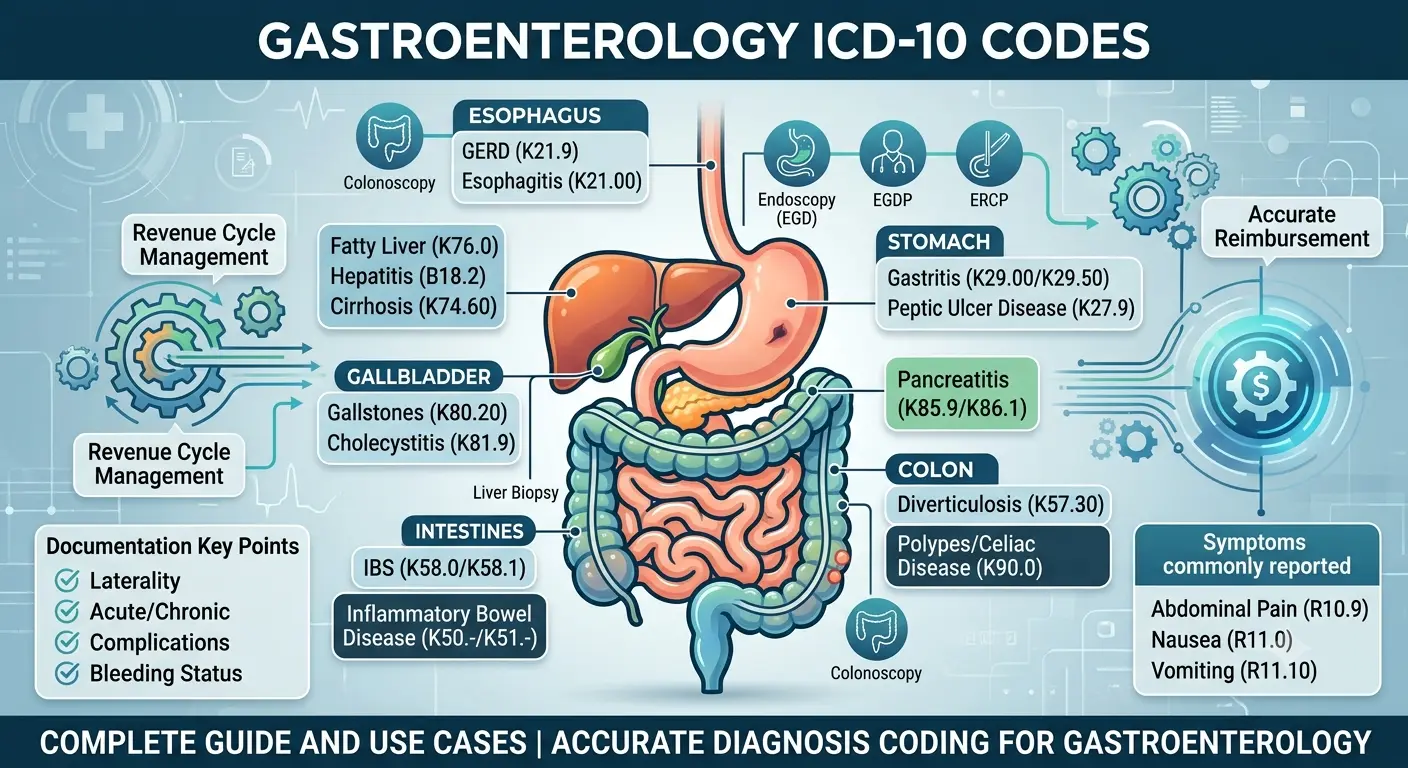
Gastroenterology practices rely on accurate ICD-10-CM diagnosis coding to support medical necessity, ensure clean claim submission, reduce denials, and maintain compliance with payer documentation requirements. Every patient encounter involving digestive diseases must be linked to the most specific diagnosis code supported by clinical documentation. From gastroesophageal reflux disease (GERD) and gastritis to Crohn’s disease, ulcerative colitis, hepatitis, and irritable bowel syndrome (IBS), selecting the correct ICD-10 code directly impacts reimbursement and coding accuracy.
This comprehensive guide explains the most frequently used Gastroenterology ICD-10 codes, documentation guidelines, coding examples, billing considerations, and common coding mistakes healthcare providers should avoid.
What Are Gastroenterology ICD-10 Codes?
ICD-10-CM (International Classification of Diseases, Tenth Revision, Clinical Modification) is the diagnosis coding system used throughout the United States for reporting diseases, symptoms, injuries, and medical conditions.
Within gastroenterology, ICD-10 codes describe disorders involving the:
- Esophagus
- Stomach
- Small intestine
- Colon
- Rectum
- Anus
- Liver
- Gallbladder
- Pancreas
- Biliary tract
These diagnosis codes establish medical necessity for services including:
- Colonoscopy
- Upper GI endoscopy (EGD)
- ERCP
- Capsule endoscopy
- Liver biopsy
- Motility studies
- Imaging procedures
- Office consultations
- Hospital care
Why Accurate Gastroenterology ICD-10 Coding Matters
Proper diagnosis coding helps healthcare organizations:
- Reduce claim denials
- Support medical necessity
- Improve reimbursement
- Ensure audit compliance
- Meet CMS documentation standards
- Generate accurate quality reporting
- Reduce payer requests for additional documentation
Even minor diagnosis coding errors can delay payment or result in claim rejection.
Most Common Gastroenterology ICD-10 Codes
The following table includes commonly reported gastroenterology diagnosis codes used in physician offices, outpatient facilities, ambulatory surgery centers, and hospitals.
| Condition | ICD-10 Code |
|---|---|
| Gastroesophageal reflux disease without esophagitis | K21.9 |
| Gastroesophageal reflux disease with esophagitis | K21.00 |
| Acute gastritis without bleeding | K29.00 |
| Chronic gastritis | K29.50 |
| Peptic ulcer disease | K27.9 |
| Duodenal ulcer | K26.9 |
| Gastric ulcer | K25.9 |
| Irritable bowel syndrome with diarrhea | K58.0 |
| Irritable bowel syndrome without diarrhea | K58.9 |
| Constipation | K59.00 |
| Functional diarrhea | K59.1 |
| Diverticulosis of colon without perforation or abscess | K57.30 |
| Diverticulitis without perforation | K57.32 |
| Hemorrhoids | K64.9 |
| Anal fissure | K60.2 |
| Crohn’s disease | K50.- |
| Ulcerative colitis | K51.- |
| Celiac disease | K90.0 |
| Fatty liver | K76.0 |
| Liver cirrhosis | K74.60 |
| Chronic hepatitis | K73.9 |
| Acute pancreatitis | K85.9 |
| Chronic pancreatitis | K86.1 |
| Cholelithiasis without obstruction | K80.20 |
| Cholecystitis | K81.9 |
| Gastrointestinal hemorrhage | K92.2 |
| Nausea | R11.0 |
| Vomiting | R11.10 |
| Dysphagia | R13.10 |
| Abdominal pain, unspecified | R10.9 |
GERD ICD-10 Codes
Gastroesophageal reflux disease (GERD) is one of the most frequently diagnosed digestive disorders.
Common codes include:
| Diagnosis | ICD-10 |
|---|---|
| GERD without esophagitis | K21.9 |
| GERD with esophagitis | K21.00 |
Clinical documentation should clearly identify:
- Presence of esophagitis
- Chronic symptoms
- Response to medication
- Endoscopy findings
Gastritis ICD-10 Coding
Gastritis coding depends on:
- Acute versus chronic
- Presence of bleeding
- Underlying cause
Examples include:
| Condition | ICD-10 |
|---|---|
| Acute gastritis without bleeding | K29.00 |
| Acute gastritis with bleeding | K29.01 |
| Chronic gastritis without bleeding | K29.50 |
| Chronic gastritis with bleeding | K29.51 |
Documentation should specify bleeding when present because it changes code selection.
Inflammatory Bowel Disease (IBD) ICD-10 Codes
Inflammatory bowel disease includes:
- Crohn’s disease
- Ulcerative colitis
These conditions require highly specific coding.
Crohn’s Disease (K50 Category)
Documentation should include:
- Disease location
- Complications
- Fistulas
- Abscess
- Bleeding
- Obstruction
Examples include:
- K50.00 Crohn’s disease of small intestine without complications
- K50.10 Crohn’s disease of large intestine without complications
- K50.80 Crohn’s disease of both small and large intestine without complications
Ulcerative Colitis (K51 Category)
Documentation should identify:
- Disease extent
- Bleeding
- Complications
- Toxic megacolon
- Perforation
Common examples:
- K51.00 Ulcerative pancolitis without complications
- K51.20 Ulcerative proctitis without complications
- K51.30 Ulcerative rectosigmoiditis without complications
Irritable Bowel Syndrome ICD-10 Codes
IBS coding depends primarily on bowel habit.
| Diagnosis | ICD-10 |
|---|---|
| IBS with diarrhea | K58.0 |
| IBS with constipation | K58.1 |
| IBS mixed | K58.2 |
| IBS unspecified | K58.9 |
Providers should document the predominant symptom pattern to support accurate coding.
Liver Disease ICD-10 Codes
Gastroenterologists frequently diagnose liver disorders requiring specific ICD-10 coding.
Common examples include:
| Liver Disease | ICD-10 |
|---|---|
| Fatty liver | K76.0 |
| Alcoholic liver disease | K70.- |
| Liver cirrhosis | K74.60 |
| Chronic hepatitis | K73.9 |
| Hepatitis B | B16-B19 |
| Hepatitis C | B17.10, B18.2 |
Documentation should specify:
- Acute versus chronic
- Viral type
- Alcohol-related disease
- Fibrosis stage
- Cirrhosis
- Liver failure
Pancreatic Disease ICD-10 Codes
Frequently reported pancreatic diagnoses include:
| Condition | ICD-10 |
|---|---|
| Acute pancreatitis | K85.9 |
| Chronic pancreatitis | K86.1 |
| Pancreatic cyst | K86.2 |
| Pancreatic insufficiency | K86.81 |
Supporting documentation should identify:
- Cause
- Severity
- Alcohol involvement
- Gallstone association
- Necrosis
- Infection
Gallbladder Disease ICD-10 Codes
Common gallbladder diagnoses include:
| Diagnosis | ICD-10 |
|---|---|
| Gallstones without obstruction | K80.20 |
| Gallstones with obstruction | K80.21 |
| Acute cholecystitis | K81.0 |
| Chronic cholecystitis | K81.1 |
| Cholecystitis unspecified | K81.9 |
Imaging findings often support diagnosis selection.
Symptoms Commonly Reported in Gastroenterology
When a definitive diagnosis has not yet been established, symptom codes may be appropriate.
Examples include:
| Symptom | ICD-10 |
|---|---|
| Abdominal pain | R10.9 |
| Right upper quadrant pain | R10.11 |
| Left lower quadrant pain | R10.32 |
| Nausea | R11.0 |
| Vomiting | R11.10 |
| Dysphagia | R13.10 |
| Melena | K92.1 |
| GI bleeding | K92.2 |
| Constipation | K59.00 |
| Diarrhea | R19.7 |
Once a confirmed diagnosis is documented, report the definitive condition instead of symptom codes whenever ICD-10-CM guidelines direct.
Documentation Requirements for Gastroenterology Coding
Complete clinical documentation should include:
- Confirmed diagnosis
- Affected organ
- Disease severity
- Acute or chronic status
- Complications
- Bleeding status
- Disease location
- Diagnostic test results
- Endoscopy findings
- Relevant pathology reports
- Treatment plan
- Follow-up recommendations
Detailed documentation improves coding specificity and reduces payer scrutiny.
Common Gastroenterology Coding Mistakes
Healthcare providers and coders should avoid the following errors:
- Selecting unspecified diagnosis codes when more specific documentation is available.
- Reporting symptom codes after a definitive diagnosis has been established.
- Omitting bleeding status in gastritis or ulcers.
- Failing to document Crohn’s disease location.
- Coding ulcerative colitis without disease extent.
- Missing complication codes.
- Ignoring laterality or anatomical specificity where applicable.
- Linking procedures to unsupported diagnoses.
- Using outdated ICD-10-CM codes after annual updates.
Routine coding audits help identify these issues before claims are submitted.
Examples of Gastroenterology ICD-10 Coding Scenarios
Example 1
Diagnosis: GERD without esophagitis
ICD-10 Code: K21.9
Example 2
Diagnosis: Chronic gastritis with bleeding
ICD-10 Code: K29.51
Example 3
Diagnosis: Crohn’s disease of the small intestine without complications
ICD-10 Code: K50.00
Example 4
Diagnosis: IBS with constipation
ICD-10 Code: K58.1
Example 5
Diagnosis: Fatty liver confirmed by ultrasound
ICD-10 Code: K76.0
Tips for Accurate Gastroenterology ICD-10 Coding
To improve coding accuracy and reimbursement:
- Verify diagnosis details in the provider’s documentation before assigning codes.
- Use the highest level of ICD-10-CM specificity available.
- Capture associated complications, such as bleeding, perforation, obstruction, or fistulas, when documented.
- Review annual ICD-10-CM updates to ensure current code selection.
- Match diagnosis codes to the medical necessity requirements for procedures like colonoscopy, EGD, ERCP, and capsule endoscopy.
- Perform routine internal coding audits to identify documentation gaps and reduce payer denials.
Frequently Asked Questions
What is the most common Gastroenterology ICD-10 code?
One of the most frequently reported codes is K21.9, which represents gastroesophageal reflux disease (GERD) without esophagitis. Other common codes include K58.9 for irritable bowel syndrome, K29.50 for chronic gastritis, and K76.0 for fatty liver.
Can symptom codes be reported in gastroenterology?
Yes. Symptom codes such as abdominal pain, nausea, vomiting, and diarrhea may be reported when a definitive diagnosis has not yet been established. If a confirmed diagnosis is documented, the condition code is generally reported instead of the symptom code, following ICD-10-CM coding guidelines.
How often are Gastroenterology ICD-10 codes updated?
The ICD-10-CM code set is updated annually, with revisions typically becoming effective on October 1 each year. Coders should review yearly updates to ensure compliance and accurate billing.
Why is documentation important for gastroenterology coding?
Comprehensive documentation supports accurate code assignment, establishes medical necessity, minimizes claim denials, and ensures compliance with payer and regulatory requirements. Details such as disease location, severity, complications, and diagnostic findings are essential for selecting the most specific ICD-10 code.
Conclusion
Accurate Gastroenterology ICD-10 coding is essential for efficient revenue cycle management, compliant medical billing, and proper reimbursement. By selecting the most specific diagnosis code, documenting disease severity and complications, and following current ICD-10-CM guidelines, providers can improve claim acceptance rates and reduce costly coding errors. Whether treating GERD, gastritis, inflammatory bowel disease, liver disorders, pancreatic conditions, or gallbladder disease, precise diagnosis coding remains the foundation of successful gastroenterology billing and clinical documentation.
Meta Title: Gastroenterology ICD-10 Codes: Complete Guide and Common Diagnosis Codes (2026)
Meta Description: Learn the most common Gastroenterology ICD-10 codes, including GERD, gastritis, Crohn’s disease, ulcerative colitis, IBS, liver disease, pancreatitis, and billing documentation tips for accurate coding.