
Shoulder pain is one of the most common musculoskeletal complaints seen in primary care, orthopedics, pain management, sports medicine, and physical therapy. Correct ICD-10-CM coding is essential because insurance companies expect providers to report the most accurate diagnosis supported by the medical record.
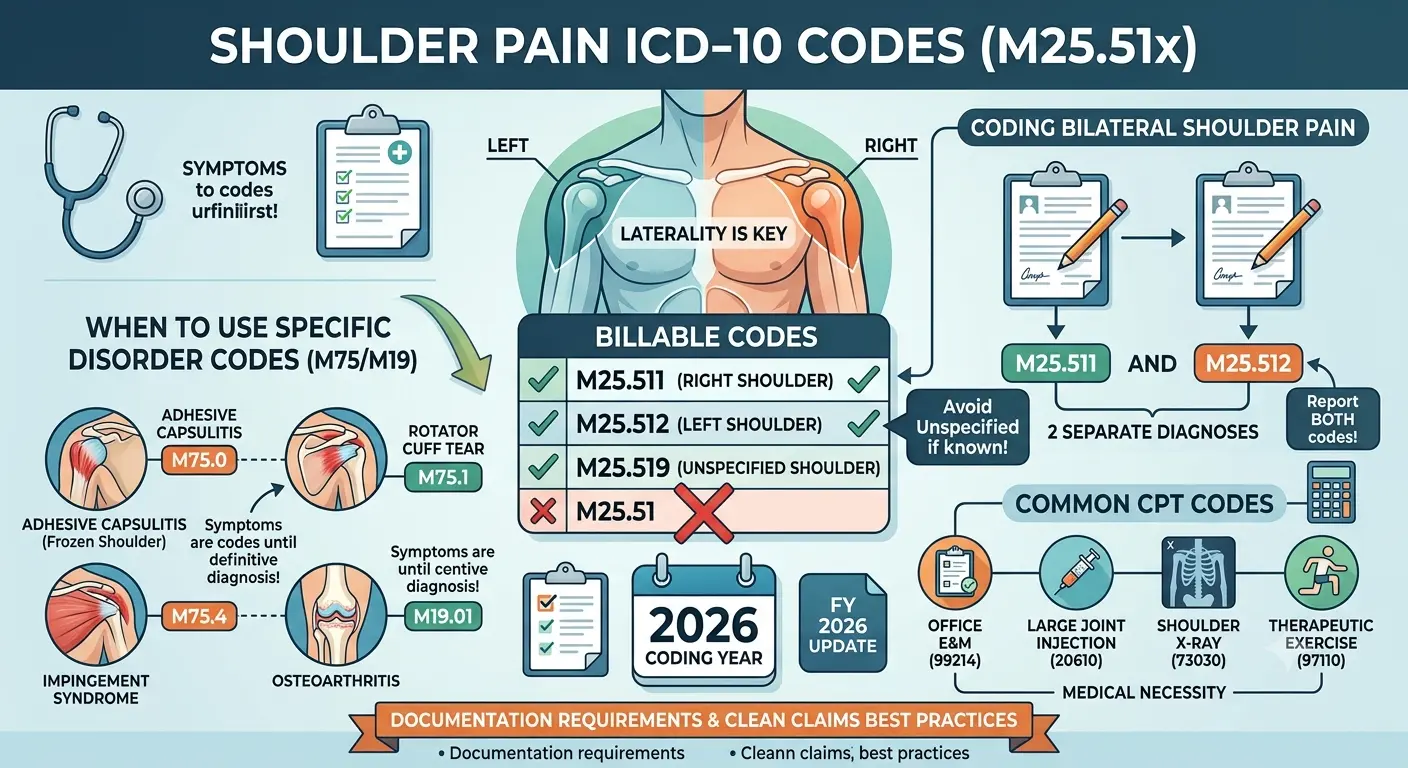
For FY 2026, shoulder pain is reported using the M25.51x code family. Since ICD-10-CM requires laterality, coders must identify whether the pain affects the right shoulder, left shoulder, or an unspecified shoulder before submitting a claim. The parent code M25.51 is not billable and should never appear on a reimbursement claim.
This guide explains the correct ICD-10 shoulder pain codes, documentation requirements, common coding mistakes, related diagnosis codes, and CPT pairings to help reduce denials and improve coding accuracy.
ICD-10 Codes for Shoulder Pain
The ICD-10-CM category M25.51 represents pain located in the shoulder joint. To create a billable diagnosis, the provider must document which shoulder is affected.
| ICD-10 Code | Description | Billable |
|---|---|---|
| M25.511 | Pain in right shoulder | Yes |
| M25.512 | Pain in left shoulder | Yes |
| M25.519 | Pain in unspecified shoulder | Yes |
| M25.51 | Pain in shoulder (parent code) | No |
Whenever possible, avoid using the unspecified code because most payers expect laterality when it is documented in the medical record.
Why Laterality Matters
Laterality is a mandatory ICD-10-CM requirement for many musculoskeletal conditions. Providers should clearly state whether the pain involves the right or left shoulder.
For example:
- Right shoulder pain → M25.511
- Left shoulder pain → M25.512
- Shoulder side not documented → M25.519
Before assigning an unspecified diagnosis, review physician notes, imaging reports, therapy documentation, and procedure reports. These records often identify the affected side even when the assessment section does not.
Coding Bilateral Shoulder Pain
ICD-10-CM does not provide a single diagnosis code for bilateral shoulder pain.
Instead, report both:
- M25.511 – Right shoulder pain
- M25.512 – Left shoulder pain
Using both diagnosis codes accurately reflects the patient’s condition and supports medical necessity when treatment is provided for each shoulder.
Shoulder Pain vs. Specific Shoulder Disorders
Pain codes should be used only while the underlying cause remains unknown. Once the physician confirms a diagnosis through clinical examination or imaging, the symptom code should be replaced with the definitive diagnosis whenever appropriate.
Common examples include:
| Condition | ICD-10 Category |
|---|---|
| Adhesive capsulitis (Frozen shoulder) | M75.0 |
| Rotator cuff tear | M75.1 |
| Bicipital tendinitis | M75.2 |
| Calcific tendinitis | M75.3 |
| Shoulder impingement syndrome | M75.4 |
| Shoulder bursitis | M75.5 |
| Primary shoulder osteoarthritis | M19.01 |
Continuing to report shoulder pain after a confirmed diagnosis may result in undercoding and unnecessary payer review.
Coding Traumatic Shoulder Injuries
Not every shoulder complaint belongs in the M25 or M75 categories.
When pain results from an acute injury, ICD-10-CM generally requires an S-code instead of a musculoskeletal pain code.
Examples include:
- Shoulder dislocation
- Shoulder sprain
- Traumatic rotator cuff injury
- Tendon injuries caused by accidents
These injury codes also require the correct seventh character to identify the encounter type, such as initial treatment, subsequent care, or sequela.
Common CPT Codes Used With Shoulder Pain
Diagnosis codes establish medical necessity for many shoulder-related procedures. The CPT code depends on the service performed rather than the diagnosis itself.
Frequently reported procedures include:
| Procedure | CPT Code |
|---|---|
| Office Evaluation & Management | 99202–99215 |
| Large joint injection | 20610 |
| Ultrasound-guided shoulder injection | 20611 |
| Tendon sheath injection | 20550 |
| Suprascapular nerve block | 64418 |
| Shoulder X-ray | 73030 |
| MRI Shoulder (without contrast) | 73221 |
| Therapeutic exercise | 97110 |
Every procedure must be supported by physician documentation describing the patient’s symptoms, examination findings, diagnosis, and medical necessity.
Documentation Requirements
Accurate coding begins with complete clinical documentation. Providers should include enough detail to justify both the diagnosis and any procedures performed.
Documentation should identify:
- Which shoulder is affected
- Duration of symptoms
- Cause of pain, if known
- Physical examination findings
- Imaging results when available
- Final diagnosis, if established
- Planned treatment or follow-up
If MRI or ultrasound confirms conditions such as a rotator cuff tear or adhesive capsulitis, the diagnosis should be updated accordingly rather than continuing to use a symptom code.
Common Coding Mistakes
Several avoidable errors frequently lead to claim delays or denials.
The most common include:
- Reporting the non-billable parent code M25.51
- Using M25.519 even though laterality is documented
- Continuing to code shoulder pain after a definitive diagnosis is confirmed
- Assigning musculoskeletal pain codes for traumatic injuries that require S-codes
- Selecting CPT codes that are not supported by the provider’s documentation
Performing a documentation review before claim submission can significantly reduce these errors.
Best Practices for Clean Claims
Healthcare organizations can improve reimbursement by following several coding best practices.
- Always document and code the correct shoulder laterality.
- Review imaging reports before selecting a diagnosis code.
- Replace symptom codes with confirmed diagnoses whenever appropriate.
- Use injury codes for traumatic conditions.
- Ensure diagnosis codes support the medical necessity of the billed CPT procedures.
- Keep coding staff updated with annual ICD-10-CM revisions.
Conclusion
The M25.51x ICD-10-CM code family remains the standard for reporting shoulder pain during the 2026 coding year. Selecting the correct laterality code—M25.511, M25.512, or M25.519—is essential for accurate reimbursement and compliance.
Equally important is recognizing when shoulder pain is only a symptom. Once a provider identifies the underlying condition, coders should transition to the appropriate diagnosis, such as a rotator cuff tear, adhesive capsulitis, bursitis, or osteoarthritis. Combining precise documentation with accurate ICD-10 and CPT coding helps reduce denials, improves claim acceptance rates, and supports proper reimbursement across orthopedic, pain management, and primary care practices.