Accurate billing for CPT code 64510 requires more than selecting the correct procedure code. Payers frequently review stellate ganglion block claims for proper diagnosis coding, laterality, image guidance, and documentation. Missing any of these elements can lead to denials or payment delays.
This guide explains when CPT 64510 should be reported, which modifiers apply, documentation requirements, and best practices for maximizing reimbursement.
What Is CPT Code 64510?
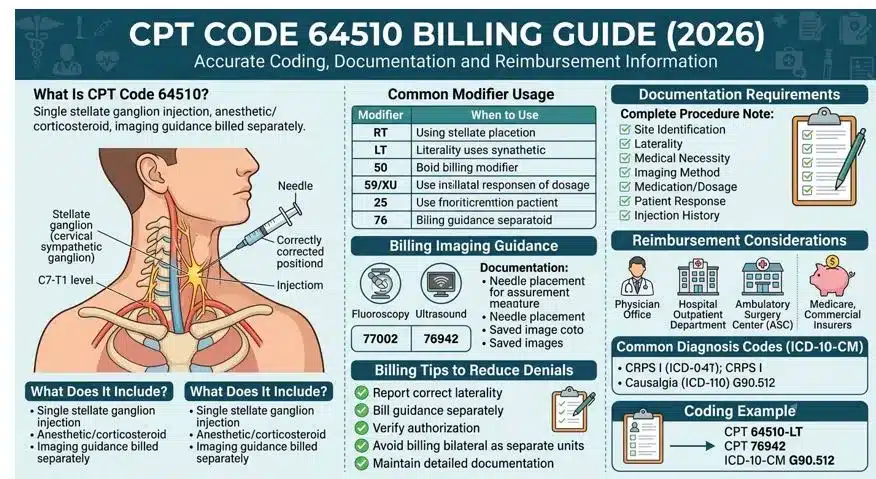
CPT 64510 describes the injection of an anesthetic agent into the stellate ganglion, also known as the cervical sympathetic ganglion.
The stellate ganglion is located near the C7-T1 vertebral level and is part of the sympathetic nervous system. Blocking this nerve helps interrupt abnormal pain signals affecting the head, neck, shoulder, and upper extremities.
Providers commonly perform this procedure for patients with complex regional pain syndrome (CRPS), sympathetically maintained pain, vascular disorders, and certain chronic pain conditions.
What Does CPT 64510 Include?
CPT 64510 reports a single stellate ganglion injection regardless of whether the physician administers:
- Local anesthetic only
- Local anesthetic combined with corticosteroid
The code represents the injection itself. Imaging guidance is billed separately, making accurate code selection essential for proper reimbursement.
Common Modifier Usage
Correct modifier assignment helps prevent claim rejections.
| Modifier | When to Use |
|---|---|
| RT | Right-side stellate ganglion block |
| LT | Left-side stellate ganglion block |
| 50 | Bilateral procedure performed during the same session |
| 59 / XU | Distinct procedural service when supported by documentation |
| 25 | Significant, separately identifiable E/M service (reported on the E/M code) |
| 76 | Repeat procedure by the same physician on the same day |
Always ensure the operative report supports every modifier billed.
Billing Imaging Guidance
Image guidance is not included in CPT 64510.
Report the appropriate imaging code based on the technique used:
- 77002 – Fluoroscopic needle guidance
- 76942 – Ultrasound guidance
Documentation should clearly identify:
- Imaging modality used
- Needle placement
- Saved images (when required)
- Relevant anatomical structures visualized
Many providers prefer ultrasound because it improves visualization of nearby vessels and soft tissues while reducing procedural risk.
Documentation Requirements
Strong documentation is one of the most effective ways to reduce denials.
A complete procedure note should include:
- Identification of the stellate ganglion as the injection site
- Right, left, or bilateral laterality
- Medical necessity with the appropriate diagnosis
- Imaging method used
- Medication name and dosage
- Patient response following the injection
- Previous injection history when part of a treatment series
Incomplete documentation frequently results in payment delays or post-payment audits.
Reimbursement Considerations
Medicare reimbursement for CPT 64510 is based on the annual Physician Fee Schedule, geographic adjustments, and place of service. Payment varies depending on whether the procedure is performed in:
- Physician office
- Hospital outpatient department
- Ambulatory surgery center (ASC)
Commercial insurers often reimburse at rates above Medicare but commonly require prior authorization, particularly for repeat sympathetic nerve blocks.
Practices should verify payer policies before scheduling the procedure to avoid unnecessary denials.
Common Diagnosis Codes
Medical necessity should be supported with diagnosis codes that reflect sympathetically mediated pain.
Common ICD-10-CM codes include:
| ICD-10 Code | Description |
|---|---|
| G90.511 | CRPS I of right upper limb |
| G90.512 | CRPS I of left upper limb |
| G90.513 | CRPS I of bilateral upper limbs |
| G90.519 | CRPS I of unspecified upper limb |
| G56.4- | Causalgia (CRPS II) of the upper limb |
Whenever possible, use the most specific diagnosis available rather than unspecified codes.
Billing Tips to Reduce Denials
Following a few best practices can significantly improve first-pass claim acceptance:
- Report the correct laterality modifier (RT or LT).
- Bill fluoroscopy or ultrasound guidance separately when appropriate.
- Verify prior authorization requirements before treatment.
- Avoid billing bilateral procedures as two separate units; use modifier 50 when supported.
- Maintain detailed documentation showing the patient’s clinical improvement if multiple blocks are performed.
- Review National Correct Coding Initiative (NCCI) edits before submitting claims involving multiple procedures.
Example Coding Scenario
A patient with left upper-extremity CRPS undergoes an ultrasound-guided stellate ganglion block.
Coding Example
- CPT: 64510-LT
- CPT: 76942
- ICD-10-CM: G90.512
This coding combination accurately identifies the procedure, laterality, imaging guidance, and medical necessity.
Conclusion
CPT 64510 is an important pain management procedure that requires careful coding and documentation. Correct use of modifiers, separate reporting of imaging guidance, accurate diagnosis coding, and complete procedural notes all contribute to cleaner claims and faster reimbursement. By following payer guidelines and maintaining detailed clinical documentation, healthcare providers can reduce denials while improving revenue cycle performance for stellate ganglion block procedures.