
Gastritis is one of the most frequently diagnosed gastrointestinal conditions in primary care and gastroenterology practices. The disorder refers to inflammation of the stomach lining and may occur suddenly (acute) or develop gradually over time (chronic). Because treatment, documentation, and reimbursement vary based on the type of gastritis, selecting the correct ICD-10-CM code is essential for accurate medical billing.
The K29 category includes gastritis, duodenitis, and gastroduodenitis. Each diagnosis is identified by a specific code that reflects both the clinical subtype and whether bleeding is present. Missing this level of specificity is one of the leading causes of coding errors and claim denials.
This comprehensive 2026 guide explains every active K29.x ICD-10-CM code, the bleeding-status rule, Helicobacter pylori coding requirements, documentation tips, common billing mistakes, and coding best practices for gastroenterology providers.
Table of Contents
- What Is the ICD-10 Code for Gastritis?
- Complete K29.x Code Reference
- Understanding the K29 Code Structure
- Gastritis ICD-10 Code Descriptions
- Duodenitis and Gastroduodenitis Codes
- Does K29.1 Exist?
- Why Bleeding Status Matters
- Coding H. pylori Gastritis
- Excludes Notes
- Common Coding Errors
- Reimbursement Considerations
- Frequently Asked Questions
What Is the ICD-10 Code for Gastritis?
The ICD-10-CM classification for gastritis falls under the K29 category, which covers gastritis, duodenitis, and gastroduodenitis.
These diagnoses are located within Chapter 11: Diseases of the Digestive System (K00–K95).
Unlike many ICD-10 categories, K29 codes require complete code selection before they become billable. The fourth character identifies the specific type of gastritis, while the fifth character indicates whether bleeding is documented.
Without both characters, the diagnosis code is considered incomplete and cannot be submitted on an insurance claim.
The current ICD-10-CM version became effective on October 1, 2025, and remains valid throughout FY 2026.
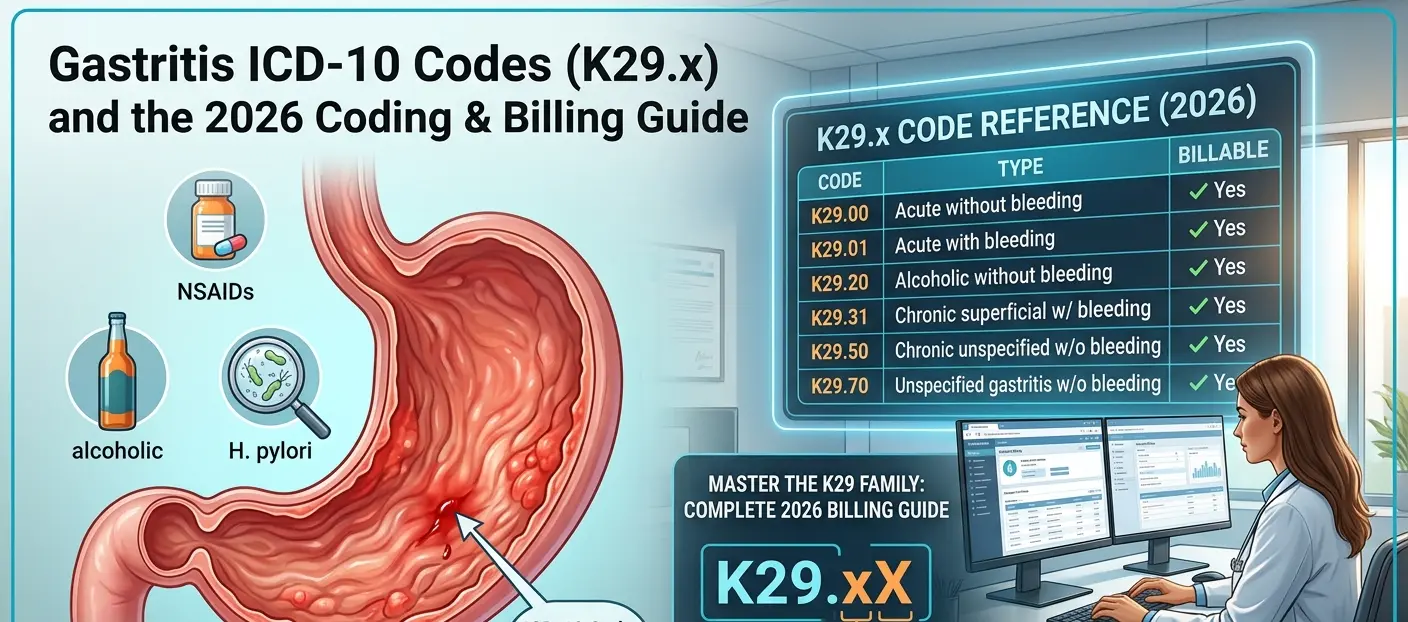
Complete K29.x Gastritis Code List
The following table summarises every billable diagnosis within the K29 family.
| ICD-10 Code | Description | Billable |
|---|---|---|
| K29.00 | Acute gastritis without bleeding | ✔ Yes |
| K29.01 | Acute gastritis with bleeding | ✔ Yes |
| K29.20 | Alcoholic gastritis without bleeding | ✔ Yes |
| K29.21 | Alcoholic gastritis with bleeding | ✔ Yes |
| K29.30 | Chronic superficial gastritis without bleeding | ✔ Yes |
| K29.31 | Chronic superficial gastritis with bleeding | ✔ Yes |
| K29.40 | Chronic atrophic gastritis without bleeding | ✔ Yes |
| K29.41 | Chronic atrophic gastritis with bleeding | ✔ Yes |
| K29.50 | Chronic gastritis, unspecified, without bleeding | ✔ Yes |
| K29.51 | Chronic gastritis, unspecified, with bleeding | ✔ Yes |
| K29.60 | Other gastritis without bleeding | ✔ Yes |
| K29.61 | Other gastritis with bleeding | ✔ Yes |
| K29.70 | Gastritis, unspecified, without bleeding | ✔ Yes |
| K29.71 | Gastritis, unspecified, with bleeding | ✔ Yes |
| K29.80 | Duodenitis without bleeding | ✔ Yes |
| K29.81 | Duodenitis with bleeding | ✔ Yes |
| K29.90 | Gastroduodenitis, unspecified, without bleeding | ✔ Yes |
| K29.91 | Gastroduodenitis, unspecified, with bleeding | ✔ Yes |
The K29 category contains 18 billable diagnosis codes grouped into nine diagnostic families. It is important to remember that parent codes such as K29, K29.0, or K29.7 are category headings only and cannot be reported on claims.
Another important point is that K29.1 is not an active ICD-10-CM code.
Understanding the K29 Code Structure
The K29 coding system follows a consistent format that helps coders identify the correct diagnosis quickly.
The fourth character identifies the disease category, while the fifth character indicates whether bleeding is present.
The fifth-character rule is the same across every K29 family:
- 0 = Without bleeding
- 1 = With bleeding
This simple pattern applies to:
- Acute gastritis
- Alcohol-induced gastritis
- Chronic superficial gastritis
- Chronic atrophic gastritis
- Chronic unspecified gastritis
- Other specified gastritis
- Unspecified gastritis
- Duodenitis
- Gastroduodenitis
Because gastrointestinal bleeding significantly affects treatment and reimbursement, coders should always verify bleeding status using endoscopy findings, pathology reports, operative notes, or physician documentation before assigning the final diagnosis code.
Gastritis ICD-10 Code Categories
The K29 classification organises gastritis into seven primary clinical groups.
Choosing the correct diagnosis always begins by identifying the documented gastritis type before determining whether bleeding is present.
K29.0 – Acute Gastritis
Acute gastritis describes sudden inflammation of the stomach lining. It commonly develops following NSAID use, alcohol consumption, acute infection, severe illness, or physiological stress.
Two billable diagnosis codes are available:
- K29.00 – Acute gastritis without bleeding
- K29.01 – Acute gastritis with bleeding
Documentation of haematemesis, melena, gastric haemorrhage, or active bleeding during endoscopy supports assigning K29.01.
K29.2 – Alcoholic Gastritis
Alcoholic gastritis occurs when chronic or excessive alcohol consumption damages the gastric mucosa.
Available diagnosis codes include:
- K29.20 – Without bleeding
- K29.21 – With bleeding
When documentation confirms alcohol dependence or alcohol use disorder, an additional diagnosis from the F10 category should also be reported when appropriate.
K29.3 – Chronic Superficial Gastritis
Chronic superficial gastritis affects only the surface layer of the gastric mucosa and is frequently confirmed through endoscopic biopsy.
Available codes include:
- K29.30 – Without bleeding
- K29.31 – With bleeding
Provider documentation describing “superficial gastritis” or pathology limited to the mucosal surface supports this category.
K29.4 – Chronic Atrophic Gastritis
Chronic atrophic gastritis involves progressive loss of gastric glands, resulting in thinning of the stomach lining.
Billable codes include:
- K29.40 – Without bleeding
- K29.41 – With bleeding
This diagnosis has greater long-term clinical importance because it is associated with vitamin B12 deficiency, intestinal metaplasia, and an increased risk of gastric carcinoma. Histopathological confirmation usually supports code assignment.
K29.5 – Chronic Gastritis, Unspecified
These codes are used when chronic gastritis is documented but no pathological subtype is identified.
Available codes include:
- K29.50 – Without bleeding
- K29.51 – With bleeding
If later documentation confirms either superficial or atrophic gastritis, coding should be updated to the more specific diagnosis.
K29.6 – Other Gastritis
This category captures less common forms of gastritis that do not fall into the standard classifications.
Examples include:
- Reactive chemical gastritis
- Giant hypertrophic gastritis
- Granulomatous gastritis
- Iron-induced gastritis
Billable codes are:
- K29.60 – Without bleeding
- K29.61 – With bleeding
When medication toxicity or chemical injury causes gastritis, additional external cause or T-series codes may also be required.
K29.7 – Gastritis, Unspecified
K29.7 is assigned when the provider documents gastritis but fails to specify whether it is acute, chronic, alcoholic, superficial, or atrophic.
Available codes include:
- K29.70 – Without bleeding
- K29.71 – With bleeding
Although these are valid billable diagnoses, excessive use of unspecified codes often triggers payer scrutiny. Whenever possible, providers should document the underlying gastritis subtype to support more specific coding and improve reimbursement.
The remaining sections—Duodenitis (K29.8), Gastroduodenitis (K29.9), H. pylori coding (B96.81), Excludes notes, common coding mistakes, reimbursement guidance, and the FAQ section—can be rewritten in the same style in Part 2 to create a complete, unique SEO article of approximately 3,500–4,500 words.