
Orthopedic HCPCS codes report braces, orthoses, medical supplies, durable medical equipment, and certain injectable drugs used in orthopedic care. Unlike CPT codes, which generally describe professional services, HCPCS Level II codes identify the physical item supplied to the patient.
For orthopedic practices, accurate HCPCS coding involves more than choosing a device description. Documentation, fitting level, prior authorization, proof of delivery, modifiers, and Medicare coverage rules can all determine whether a claim is paid.
Major HCPCS Code Groups in Orthopedics
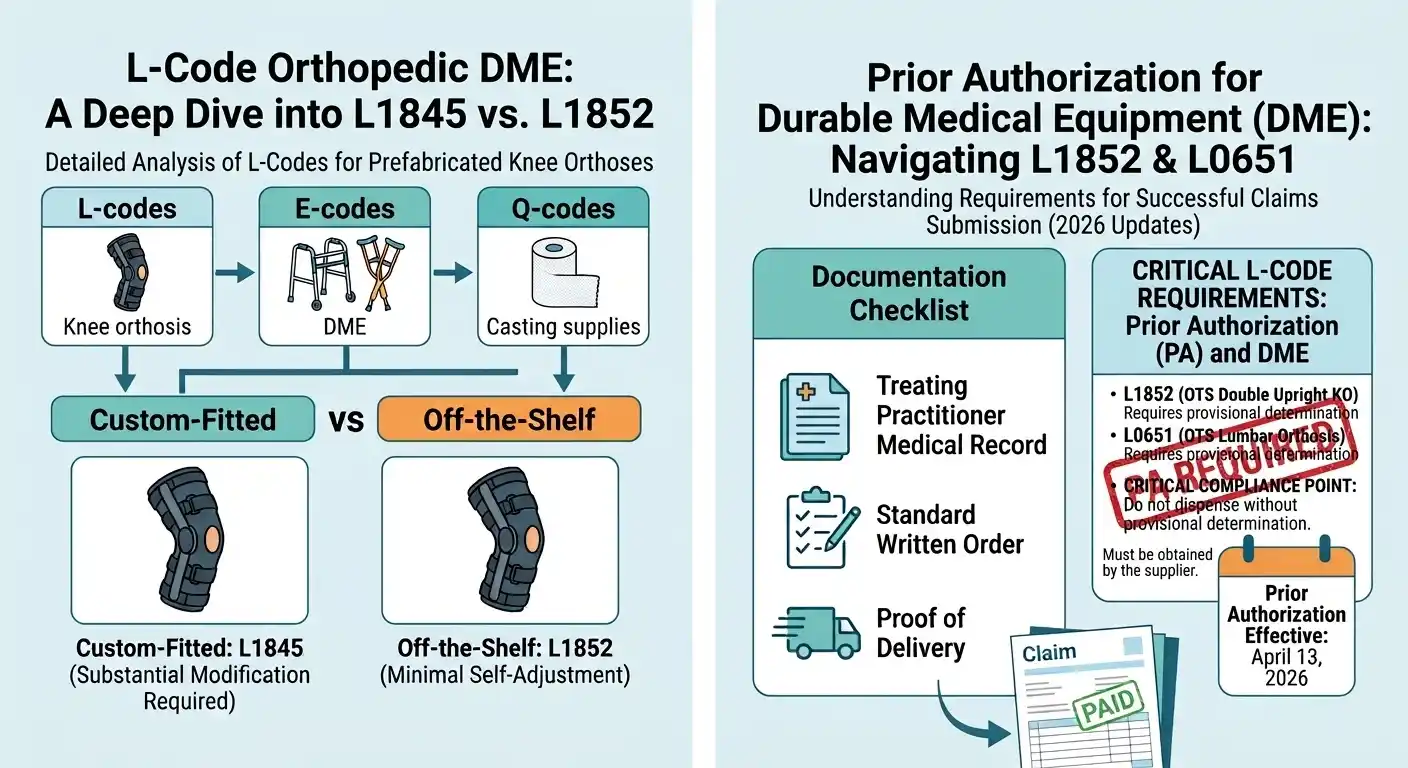
Orthopedic billing commonly uses five HCPCS Level II ranges:
- L-codes: Braces, orthoses, and prosthetic devices
- Q-codes: Cast and splint supplies
- E-codes: Durable medical equipment such as walkers and crutches
- A-codes: Supplies and non-covered items
- J-codes: Injectable drugs and biological products
L-codes generally carry the most extensive documentation and authorization requirements.
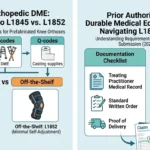
Custom-Fitted vs. Off-the-Shelf Braces
One of the most important orthopedic HCPCS distinctions is how a prefabricated brace is fitted. The physical device may be identical, but the code can change according to what happens during final fitting.
Off-the-shelf coding applies when only minimal self-adjustment is needed. This can include adjusting straps, trimming or bending the device for comfort, or assembling components. Custom-fitted coding applies when substantial modification requires specialized training.
Common paired codes include:
| Orthosis | Custom Fitted | Off-the-Shelf |
|---|---|---|
| Elastic knee orthosis | L1810 | L1812 |
| Adjustable knee orthosis | L1832 | L1833 |
| Single upright knee orthosis | L1843 | L1851 |
| Double upright knee orthosis | L1845 | L1852 |
| Pneumatic walking boot | L4360 | L4361 |
| Non-pneumatic walking boot | L4386 | L4387 |
| Static/dynamic AFO | L4396 | L4397 |
| Wrist-hand-finger orthosis | L3807 | L3809 |
Not every prefabricated orthosis has a custom-fitting counterpart. Codes such as L1902, L1906, L1930, L1932, L1951, and L1971 have no separate fitting-level choice.
Prior Authorization Rules for 2026
Medicare’s prior authorization requirements changed during 2026. Five orthopedic codes became subject to nationwide prior authorization on April 13, 2026: L0651, L1844, L1846, L1852, and L1932.
This change is particularly important for L1852, the off-the-shelf double upright knee orthosis. Suppliers that previously dispensed it without authorization must now obtain the required provisional determination before delivery.
Some orthoses also require a face-to-face encounter and standard written order before delivery. The order must accurately describe the item being supplied and correspond to the HCPCS code billed.
Documentation That Supports DMEPOS Claims
Three core documents are essential for orthopedic DMEPOS claims:
- Standard written order
- Treating practitioner’s medical record
- Proof of delivery
Documentation problems are a major source of improper payments. CMS data cited in the source show insufficient documentation accounted for 64.4% and missing documentation for another 20.1% of lumbar-sacral orthosis improper payments.
Proof of delivery deserves particular attention. A supplier may have a correct order and detailed medical record, but failure to produce delivery documentation can still result in recoupment.
Common Orthopedic Braces and Equipment
Frequently billed orthopedic L-codes include knee orthoses, walking boots, ankle-foot orthoses, upper-limb braces, and lumbar-sacral orthoses. For example, L1833 identifies an off-the-shelf adjustable knee joint orthosis, while L4361 identifies a pneumatic walking boot supplied off the shelf. L3908 reports a prefabricated wrist extension-control orthosis.
Spinal orthoses include codes such as L0648, L0650, L0651, L0631, L0637, and L0639. These codes differ according to the type of spinal control and fitting level.
Supplies, Mobility Devices, and Injectables
Orthopedic HCPCS billing extends beyond braces. E0143 reports a folding wheeled walker, while E0135 identifies a folding pickup walker. E0114 and E0110 report underarm and forearm crutches respectively. Equipment status may require modifiers such as NU for new equipment, RR for rental, or UE for used equipment.
Cast materials are reported separately from cast application services. For example, Q4038 covers adult fiberglass short-leg cast material, while Q4010 covers adult fiberglass short-arm cast material. The CPT application code reports the professional work, while the HCPCS code reports the material.
J-codes are used for orthopedic injectable drugs. Examples include J7325 for Synvisc and Synvisc-One, J7323 for Euflexxa, J3301 for triamcinolone acetonide, and J1100 for dexamethasone sodium phosphate. Units must always follow the specific HCPCS descriptor rather than simply matching vial or syringe size.
Modifiers and Denial Prevention
Orthopedic claims may require modifiers such as KX, GA, GY, GZ, RT, LT, NU, RR, UE, and ST. Each serves a different purpose, from documenting coverage requirements and laterality to identifying equipment status or urgent delivery.
The most effective denial-prevention strategy is to verify the device, fitting level, medical record, authorization status, order, and proof of delivery before submission. A correct diagnosis alone does not guarantee reimbursement. Orthopedic HCPCS claims succeed when the code, device, documentation, and Medicare requirements all tell the same clinical story.