
CPT 96415 is an add-on code used for prolonged chemotherapy administration by intravenous infusion. It applies to each additional hour of infusion after the initial hour has been reported with the appropriate primary chemotherapy administration code. Although the concept sounds straightforward, accurate billing depends on more than simply counting the hours documented in an infusion record.
For oncology practices, the difference between correct and incorrect use often comes down to infusion sequence, documented times, drug changes, and payer-specific requirements.
Understanding CPT 96415
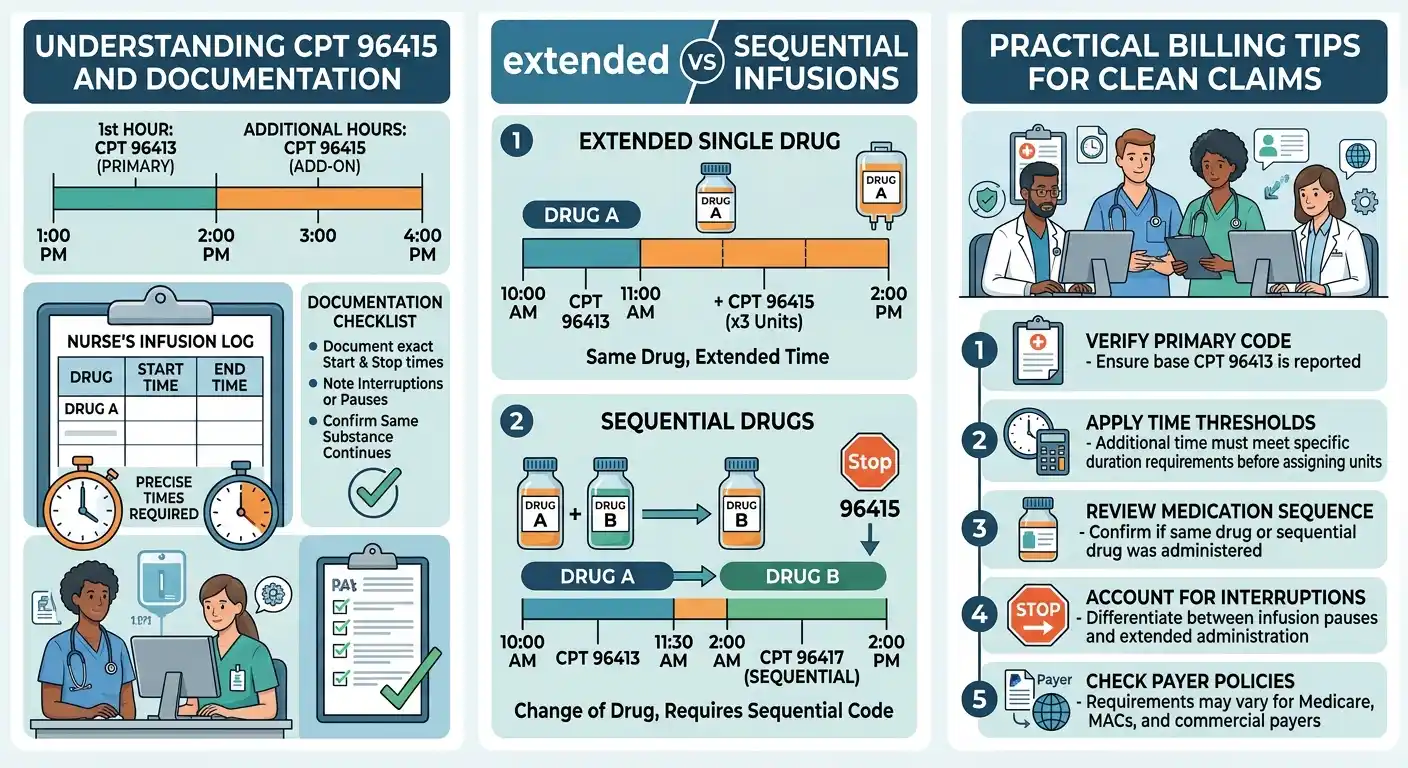
CPT 96415 represents each additional hour of intravenous chemotherapy infusion. Because it is an add-on code, it cannot be reported by itself. It is generally reported with CPT 96413 when the same chemotherapy substance continues beyond the initial infusion period.
For example, if a chemotherapy drug is administered continuously for three hours, the first hour is represented by the primary infusion code, while the qualifying additional hours may be reported with 96415.
The key issue is that coders must establish what happened during the entire infusion. A longer appointment does not automatically mean additional units of 96415. The medical record must support the actual administration time and show that the qualifying infusion continued.
Why Accurate Time Documentation Matters
Time is central to this code. Infusion records should clearly identify when administration began and ended. Any interruptions, pauses, medication changes, or other events that affect administration time should also be documented.
Consider a patient who receives chemotherapy for 90 minutes. The record supports the initial infusion, but the additional time does not meet the required threshold for another hour. Reporting an extra unit simply because the patient remained in the infusion center would not be appropriate.
Conversely, when an infusion continues long enough to satisfy the additional-hour requirement, failing to report 96415 can result in missed reimbursement.
This makes nursing documentation particularly important. Start and stop times should be precise rather than based on approximate statements such as “patient received chemotherapy for several hours.”
CPT 96415 and Changing Chemotherapy Drugs
One of the most important distinctions involves sequential drugs.
Suppose Drug A is administered first and then discontinued. Drug B begins afterward. The second infusion is not automatically an additional hour of the original service. Because the substance has changed, the coding may require a sequential chemotherapy administration code, such as CPT 96417, when applicable.
Coders should therefore review the medication administration record rather than relying only on the total chair time. The sequence of substances and the order in which they were administered can determine which administration code is appropriate.
Common Billing Situations
Several situations frequently create confusion around 96415.
Extended single-drug infusion: A patient receives one chemotherapy drug continuously for several hours. When the documented time meets the applicable threshold, 96415 can be reported for qualifying additional hours.
Short extension: An infusion continues only slightly beyond the initial hour. If the additional time does not reach the required threshold, another unit should not be added simply to reflect the longer appointment.
Sequential chemotherapy: One chemotherapy substance ends and another begins. The second service may require a sequential administration code rather than 96415.
Concurrent hydration: Fluids administered at the same time as chemotherapy may not always be separately reportable. Payer rules and the specific circumstances of the administration should be reviewed before adding a hydration code.
Premixed or combined medication: When multiple substances are prepared together as one infusion, coders should evaluate the actual administration and payer guidance rather than automatically treating each medication as a separate infusion service.
Practical Rules for Clean Claims
A reliable coding process starts with the medication administration record and the infusion timeline.
- Confirm that the primary chemotherapy administration code is reported when required.
- Verify exact infusion start and stop times.
- Determine whether the same chemotherapy substance continued during the additional time.
- Apply the appropriate time threshold before assigning another unit.
- Review interruptions and changes in medication sequence.
- Check Medicare, MAC, and commercial payer policies when requirements differ.
- Make sure documentation supports every unit submitted.
Final Takeaway
CPT 96415 is more than an “extra hour” code. Correct reporting requires the coder to connect documented infusion time with the actual chemotherapy administration sequence. A patient sitting in an infusion chair for three hours does not, by itself, establish three billable hours of chemotherapy administration.
Strong documentation, careful review of drug sequencing, and consistent application of time rules help oncology practices reduce denials while capturing legitimate reimbursement. When nurses, coders, and billing teams work from the same accurate infusion timeline, CPT 96415 becomes much easier to report correctly.