
The foundation of contemporary healthcare reimbursement, clinical documentation, and continuity of patient care lies in accurate medical coding. Of the thousands of ICD-10-CM codes, some of them are especially prevalent and common but often misinterpreted. The guide discusses the right ICD-10 code of chronic pain syndrome, the ICD-10 code of osteoporosis as well as the ICD-10 code of obstruction sleep apnea and the ICD-10 code of chronic pain (without syndrome designation). This article will make you a confident coder, whether you are a medical coder, biller, physician or a student.
ICD-10 Code for Chronic Pain Syndrome
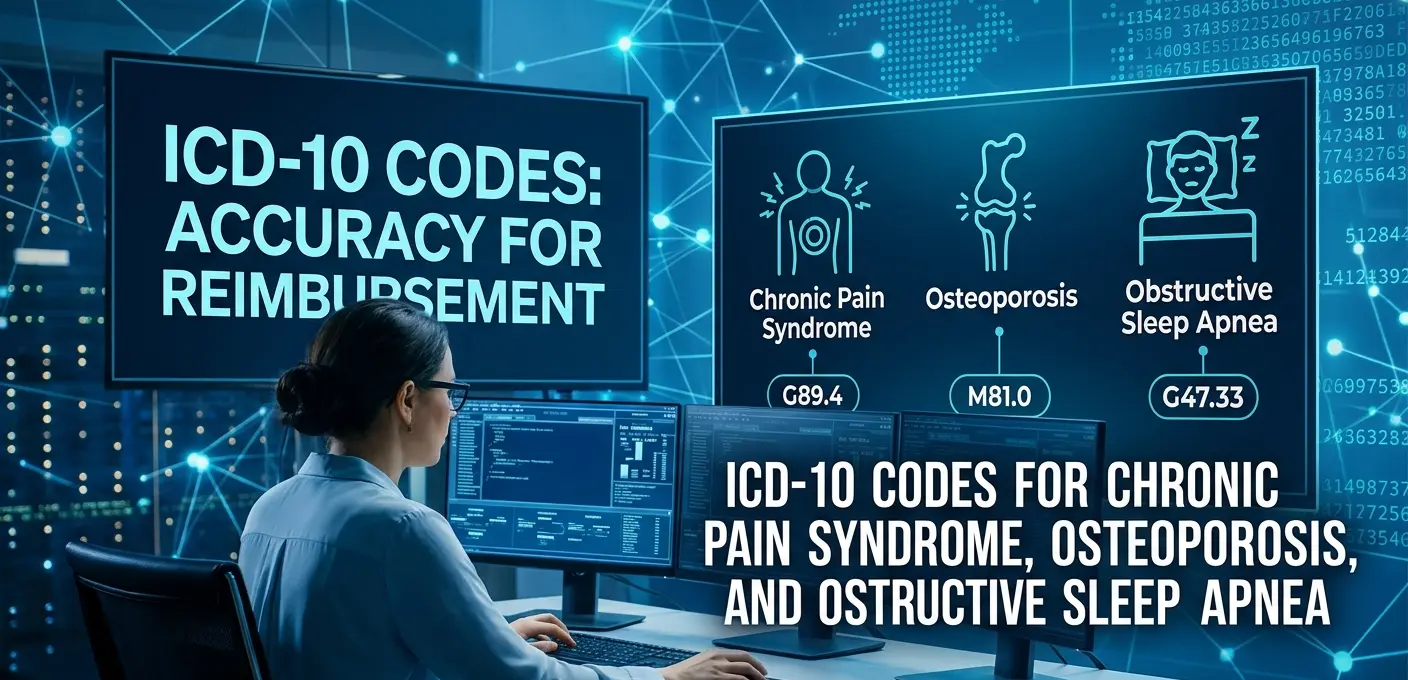
The official ICD-10 code of the chronic pain syndrome is G89.4. This code is categorized into the chronic pain syndrome as opposed to general chronic pain. The ICD-10 guidelines state that G89.4 is to be applied in cases when a patient experiences chronic pain and has a severe emotional or functional impairment. It suggests a biopsychosocial model – the pain that does not disappear in the usual healing period and it impacts on everyday life.
Clinical tip: G89.4 is not to be applied in all long-term pain. Use it when the psychological or behavioral factors are reported in conjunction with the pain.
ICD-10 Code for Chronic Pain (Without Syndrome)
In case a patient experiences chronic pain though he/she does not qualify to be considered as having a syndrome, the correct ICD-10 code to be used in chronic pain is G89.29 – Other chronic pain. Instead, G89.28 (chronic pain secondary to trauma) or G89.22 (chronic post-thoracotomy pain) can be used based on etiology. In case of generalized chronic pain without other specification, G89.29 is the most safe.
G89.4 and G89.29 are commonly mixed up by coders. Recall: G89.4 involves recording of psychological or behavioral factors. G89.29 does not.
ICD-10 Code for Osteoporosis
The osteoporosis codes should consider the site, laterality and the presence of pathological fracture. The main ICD-10 code of the osteoporosis without the current fracture is M81.0 (Age-related osteoporosis) of the majority of adult patients. Nevertheless, there are a number of subcategories:
- M80.00–M80.08 — Age-related osteoporosis with current pathological fracture (site-specific)
- M81.8 — Other osteoporosis
- M81.6 — Localized osteoporosis (Lequesne)
- M82.1 — Osteoporosis in endocrine disorders (use additional code for the underlying condition)
M81.0 is the most frequent one when it comes to postmenopausal osteoporosis without fracture. Always do verify whether there is a fracture present or not – that would then switch it to M81 to M80.
Obstructive Sleep Apnea ICD-10
My ICD-10 code is 47.33: obstruction sleep apnea. This is included in the ICD-10-CM chapter on nervous system disorders as Sleep apnea syndromes. G47.33 is applicable to obstructive sleep apnea (OSA) and does not include central sleep apnea (G47.31) or mixed sleep apnea (G47.36).
OSA is clinically defined as frequent collapses of the upper airway during sleep resulting in hypoxia and sleep fragmentation. To code, be sure that the physician has recorded obstructive sleep apnea not sleep apnea. Since the latter can be coded to G47.30 (unspecified sleep apnea).
Additional codes to consider with OSA:
- Z99.89 (Dependence on supplemental oxygen)
- Z93.90 (External stoma – if tracheostomy is present)
- E66.01 (Morbid obesity, often comorbid with OSA)
Common Coding Scenarios and Billing Tips
Scenario 1: Chronic Pain with Anxiety and Insomnia
The patient is 55 years old and has 18 months of chronic low back pain with reported anxiety and work difficulty.
Appropriate codes: G89.4 (chronic pain syndrome) + M54.50 (low back pain, unspecified) + F41.9 (anxiety). Code G89.29 should not be used here – there is a reason to use the syndrome code.
Scenario 2: Osteoporosis with Vertebral Fracture
A patient is aged and has osteoporosis due to age and a compression fracture at L2.
Appropriate codes: M80.08A (age-related osteoporosis with pathological vertebral fracture, initial encounter) + M48.56XA (collapsed vertebra, not elsewhere classified, lumbar region). Please do not use M81.0 – that is osteoporosis, no fracture.
Scenario 3: Obstructive Sleep Apnea with Obesity
A 38 BMI patient who has OSA confirmed by polysomnography.
Correct codes: G47.33 (obstructive sleep apnea) + E66.01 (morbid obesity due to excess calories) + Z68.38 (BMI 38.0–38.9). Do not use G47.30.
Documentation Best Practices for Payers
Medicare and commercial insurers often deny claims when chronic pain codes (G89.4 or G89.29) are used as primary diagnoses. Whenever possible, sequence the underlying condition first (e.g., M54.5 for low back pain) and use the chronic pain code as a secondary diagnosis. For osteoporosis, always document the site and any history of falls. For OSA, include Apnea-Hypopnea Index (AHI) values in the clinical note.
Final Quick Reference Table
| Condition | ICD-10 Code | Key Notes |
|---|---|---|
| Chronic pain syndrome | G89.4 | Requires psychological/behavioral factors |
| Chronic pain (other) | G89.29 | No syndrome criteria |
| Osteoporosis (age-related, no fracture) | M81.0 | Most common |
| Osteoporosis with fracture | M80.0–M80.8 | Use 7th character for encounter |
| Obstructive sleep apnea | G47.33 | Excludes central sleep apnea |
Conclusion
Mastering the ICD-10 code for chronic pain syndrome, the ICD-10 code for osteoporosis, the obstructive sleep apnea ICD-10 code, and the ICD-10 code for chronic pain is essential for accurate reimbursement and compliance. Always check the latest annual updates ICD-10 changes every October 1st. When in doubt, query the provider for specificity. Accurate coding is not just about payment; it is about telling the patient’s story correctly.